
How Electric Installation Huntsville AL Powers Your Home
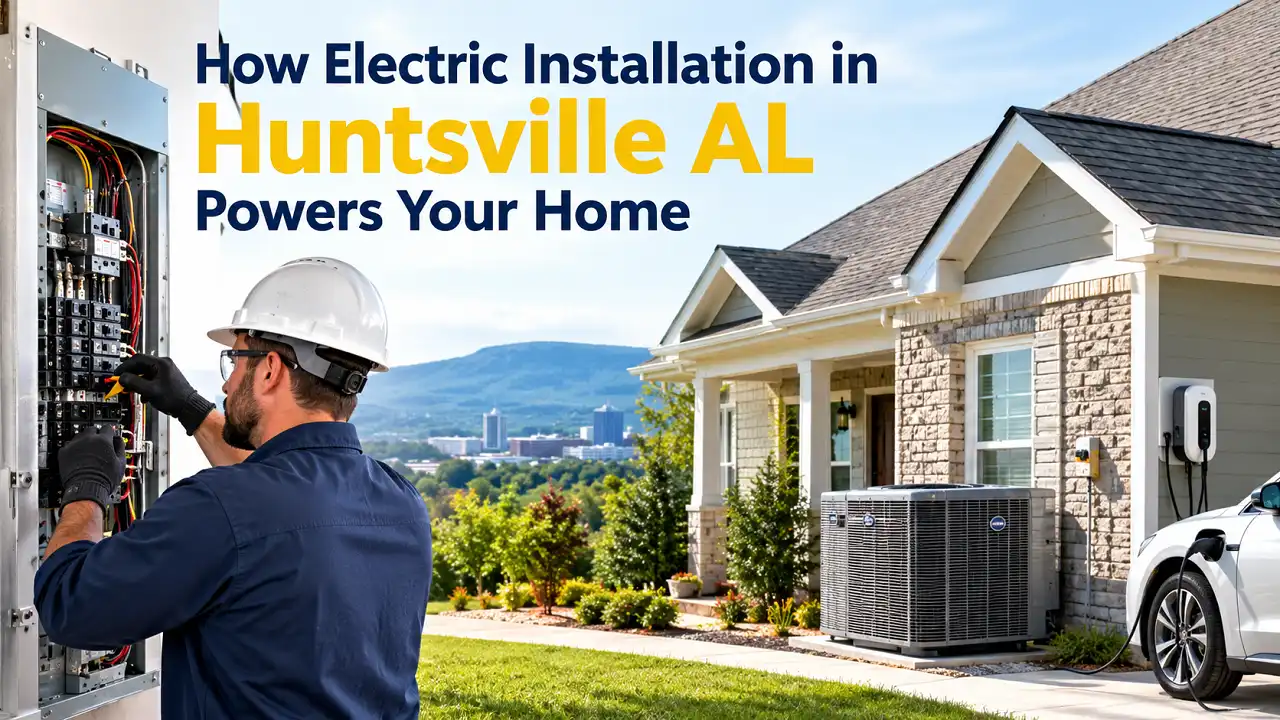
In a typical North Alabama home, your heat pump, your EV charger, and your kitchen all draw from the same electrical panel. In July, the outdoor unit can run for 10 hours or more a day through 95°F heat and heavy humidity. Every electric installation Huntsville AL homeowners schedule has to account for that load. Otherwise the result is tripped breakers, overheated connections, and failed inspections.
The cost of getting it wrong is real. An undersized circuit or a loose lug produces heat long before it fails, and that heat stays hidden behind drywall. At Huntsville AL Electricians, our Gov Certified technicians treat every new circuit as one piece of a larger system. That system includes your HVAC equipment, your service panel, and the way your family uses power.
Power Check: 3 Things to Know Before Any Install
- Run a load calculation first. A 200A panel is not automatically “enough.” NEC Article 220 math tells you whether a heat pump, EV charger, or hot tub fits.
- Match every HVAC circuit to the nameplate. The MCA (Minimum Circuit Ampacity) and MOP (Maximum Overcurrent Protection) on the condenser set the wire size and breaker size.
- Pull the permit. Panels, new circuits, generators, and EV chargers usually require a permit and inspection, which protects your insurance coverage and your resale value.
What Electric Installation Covers in a North Alabama Home
Residential electric installation means adding or replacing the equipment that delivers power through your house. That includes panels, branch circuits, wiring, devices, and dedicated appliance circuits. Every job starts at the service entrance and ends at the device you plug in or switch on.
Our Gov Certified technicians frequently see this in North Alabama homes: the homeowner installs one upgrade, and nobody checks how it affects the rest of the system. A new heat pump goes in, then a Level 2 charger, then a garage subpanel. Each one passed its own inspection. None of them were planned together.
Check Also: Electrical Troubleshooting And Repairs Huntsville AL
Types of Electric Installation Huntsville AL Homes Need Most
On recent service calls across Madison County, these jobs come up most. They are listed roughly in order of how often homeowners request them.
| Installation Type | Typical Use | Common Trigger |
|---|---|---|
| Panel upgrade (100A to 200A) | More capacity for modern loads | EV charger, heat pump, addition |
| Panel replacement | Swap failing or problem-brand panels | Federal Pacific, Zinsco, rust, heat damage |
| Home rewiring | Replace unsafe or ungrounded wiring | Knob-and-tube, cloth cable, aluminum branch wiring |
| New circuits | Dedicated appliance or room circuits | Kitchen remodel, home office, shop |
| Lighting | Recessed, under-cabinet, exterior, landscape | Remodel, security, curb appeal |
| Outlets and GFCI | Shock protection and convenience | Code updates, wet areas, garage |
| EV charger | Level 2 home charging | New electric vehicle |
| Generator hookup | Backup power with transfer switch | Storm season, medical equipment |
| Smart home wiring | Smart switches, thermostats, cameras | Automation, energy monitoring |
| HVAC circuits | Condenser, air handler, heat strips | New or replacement system |
Voltage Breakdown: What Each Installation Draws
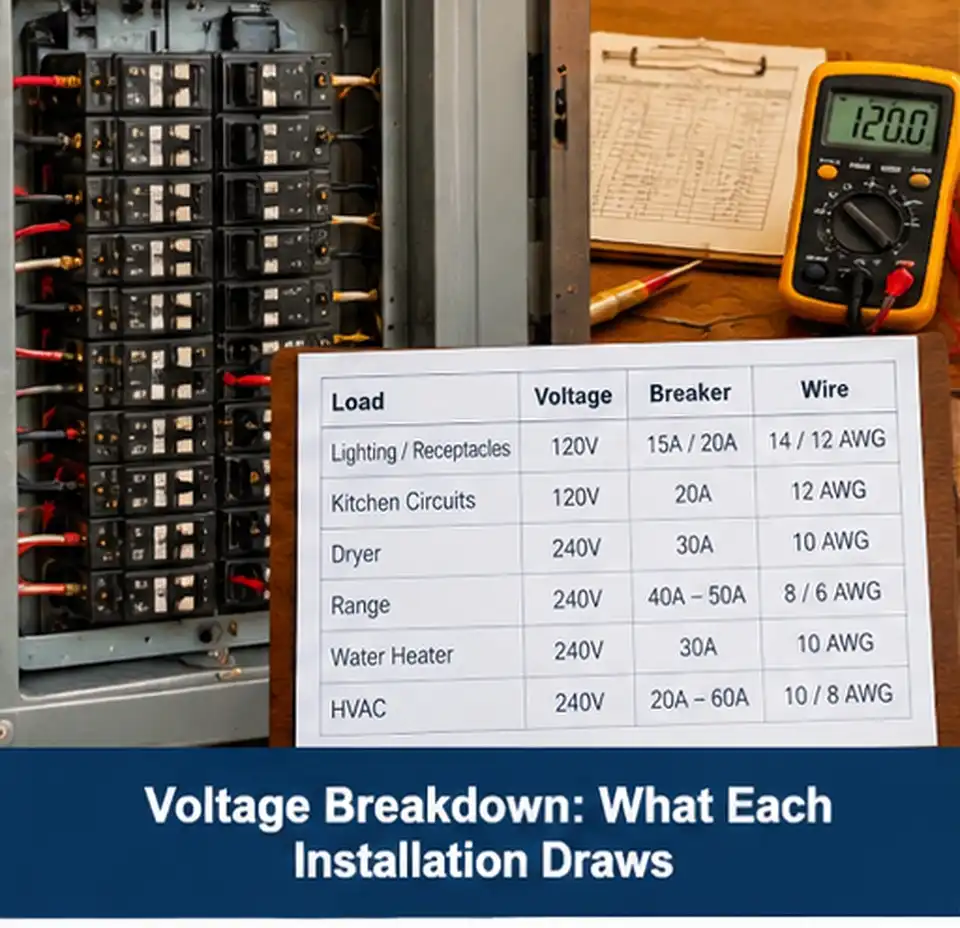
Voltage determines the type of circuit, wire, and breaker you need. Most homes use 120V for lighting and receptacles and 240V for heavy appliances. Thermostats and doorbells run on 24V control power. That control power comes from a transformer, which is usually located inside the furnace or air handler.
| Load | Voltage | Typical Breaker | Typical Copper Wire |
|---|---|---|---|
| General lighting and receptacles | 120V | 15A or 20A | 14 AWG / 12 AWG |
| Kitchen countertop circuits | 120V | 20A (min. two circuits) | 12 AWG |
| Electric dryer | 240V | 30A | 10 AWG |
| Electric range | 240V | 40A to 50A | 8 AWG / 6 AWG |
| Electric water heater | 240V | 30A | 10 AWG |
| AC condenser / heat pump | 240V | Per nameplate MOP (often 20A to 50A) | Per nameplate MCA |
| Air handler with heat strips | 240V | Often 40A to 60A | Per nameplate MCA |
| Level 2 EV charger (32A output) | 240V | 40A | 8 AWG |
| Level 2 EV charger (48A output) | 240V | 60A | 6 AWG |
| Hot tub / spa | 240V | 40A to 60A, GFCI | Per manufacturer |
| Thermostat control wiring | 24V | Transformer fuse (often 3A to 5A) | 18 AWG |
| Landscape lighting | 12V | Via transformer on 120V GFCI | Low-voltage cable |
These figures are typical starting points. Wire length, insulation type, and ambient temperature can change the final size. A hot Alabama attic often runs past 130°F in summer, and that heat lowers how much current a cable can safely carry. The next step is simple: read the nameplate on your largest appliances before you request a quote.
Panel Upgrades: Moving From 100A to 200A
A panel upgrade increases the total power your home can use at once. Many Huntsville homes built before the 1990s still run on 100-amp service. That was enough when the home had gas heat and no EV. A modern all-electric home with a heat pump, electric range, dryer, water heater, and Level 2 charger often needs 200 amps.
At Huntsville AL Electricians, we never size a panel by guesswork. We run an NEC Article 220 load calculation that totals your real loads and applies code-approved demand factors. Sometimes the math shows that your 100A service can handle a new load with a load management device. Sometimes it shows you’re already over capacity. For homes that need more room, our panel upgrade service for modern loads covers the utility coordination, meter base, and inspection.
Pros and Cons of a 200A Upgrade
Pros:
- Room for EV charging, heat pumps, and future additions
- More breaker spaces for AFCI and GFCI protection
- Replaces aging or problem-brand panels at the same time
- Often improves insurance and resale standing
Cons:
- Requires utility disconnect and coordination, which can add days to scheduling
- May require a new meter base and service entrance cable
- Higher upfront cost than adding a single circuit
- Not always necessary if a load calculation shows spare capacity
Warning Signs Your Panel Needs Attention
Panels give warnings before they fail. Watch for these:
- Breakers that feel warm or buzz under load
- Scorch marks or a burning smell near the panel cover
- Lights that dim when the AC compressor starts
- A Federal Pacific Stab-Lok or Zinsco label on the door
- Rust or water stains inside the enclosure
- No open slots left, with double-tapped breakers
Take a photo of your panel label and the main breaker rating before you call. It speeds up the conversation.
Wiring Installation: New Construction, Remodels, and Knob-and-Tube
Wiring is the part of your system you never see. That’s why mistakes there last for decades. A proper electric installation Huntsville AL inspectors will approve starts with correct wire gauge, secure box fill, and protected cable runs through attics and crawl spaces.
New Construction and Additions
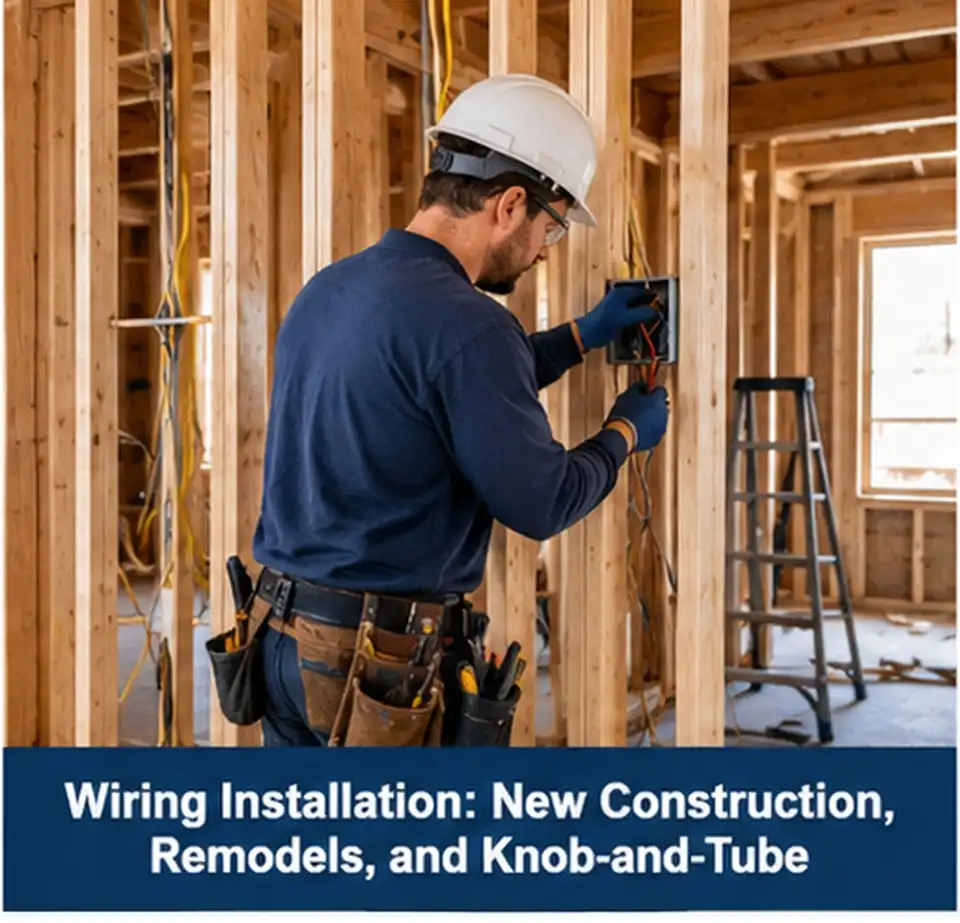
New construction wiring moves through three stages: rough-in, inspection, and trim-out. Rough-in places boxes and cable before the drywall goes up. The inspector then checks stapling, nail plates, and box fill. Trim-out installs devices, fixtures, and breakers, and then a final inspection follows.
Remodel Wiring
Kitchen and bath remodels trigger updated code requirements for the remodeled area. Expect two 20A countertop circuits, GFCI protection near sinks, and AFCI protection on most living-space circuits. Plan the electrical layout before you order cabinets. Moving one outlet after the countertop is installed costs far more than placing it right the first time.
Knob-and-Tube and Outdated Wiring
Some older homes in central Huntsville, Decatur, and Athens still contain knob-and-tube wiring. It has no ground conductor, and its rubber insulation turns brittle with age. Many insurers will not write a policy on it. Homes from the 1960s and 1970s may also have aluminum branch wiring, which loosens at terminals and runs hot.
| Wiring Type | Era | Main Risk | Typical Fix |
|---|---|---|---|
| Knob-and-tube | 1880s to 1940s | No ground, brittle insulation | Full replacement |
| Cloth-sheathed NM | 1940s to 1960s | Insulation breakdown, often ungrounded | Replacement |
| Aluminum branch wiring | 1965 to 1973 | Loose, overheating terminations | COPALUM or AlumiConn repair, or rewire |
| Modern NM-B (Romex) | 1984 to present | Damage from rodents or nails | Spot repair |
If your home has any of the first three, our whole-home rewiring service replaces unsafe cable room by room with as little wall damage as possible. Book an electrical inspection first if you’re buying an older home.
Lighting Installation
Lighting upgrades are the most visible electrical work in a home. They’re also where shortcuts show up fastest. Recessed lights need IC-rated housings when they touch insulation. Ceiling fans need a fan-rated box. Exterior fixtures need wet-location or damp-location ratings.
| Lighting Type | Key Requirement | Common Mistake |
|---|---|---|
| Recessed / wafer LED | IC-rated, airtight in insulated ceilings | Non-IC cans buried in insulation |
| Ceiling fan | Fan-rated box, proper support | Hanging on a standard light box |
| Under-cabinet | Hardwired driver or plug-in on a dedicated outlet | Overloaded countertop circuit |
| Outdoor / porch | Wet- or damp-location rating | Indoor fixture on an exposed porch |
| Landscape | Low-voltage transformer on a GFCI outlet | Undersized transformer, voltage drop |
| Security / motion | Proper sensor placement and weather seal | Aimed at the street, triggered by traffic |
LED fixtures draw a fraction of the power of incandescent bulbs. The U.S. Department of Energy’s Energy Saver resources note that switching to LEDs is one of the fastest ways to cut household lighting costs. For dimmable LED setups, you’ll need an LED-compatible dimmer, or the lights may flicker and buzz. Our lighting installation team matches dimmers, drivers, and fixtures so they work together from day one.
Outlet and GFCI Installation
A GFCI (Ground-Fault Circuit Interrupter) shuts off power when current leaks to ground, such as through a person. An AFCI (Arc-Fault Circuit Interrupter) detects dangerous arcing inside wiring and cuts power before it can start a fire. A tamper-resistant receptacle has internal shutters that block children from inserting objects. Most modern homes need all three.
Recent NEC editions expanded GFCI requirements to cover more locations and more 240V receptacles. Humid North Alabama basements and garages are exactly the damp locations these rules target. Moisture is the leading cause of nuisance GFCI trips we see in summer.
Where GFCI Protection Is Typically Required
- Bathrooms, all receptacles
- Kitchens, all receptacles serving countertops and nearby appliances
- Garages and accessory buildings
- Outdoors, including porches and decks
- Laundry areas and within 6 feet of any sink
- Basements and crawl spaces
- Pools, hot tubs, and their equipment
Troubleshooting a GFCI That Won’t Reset
- Unplug everything on that circuit, including downstream outlets.
- Press reset firmly on the GFCI.
- Check the breaker in the panel for a trip.
- Look for moisture in outdoor or garage boxes.
- Plug devices back in one at a time to find the faulty load.
- Call an electrician if it trips with nothing plugged in.
A GFCI that trips with no load usually points to a wiring fault or a failed device. Press the TEST button monthly to confirm it still works.
EV Charger Installation
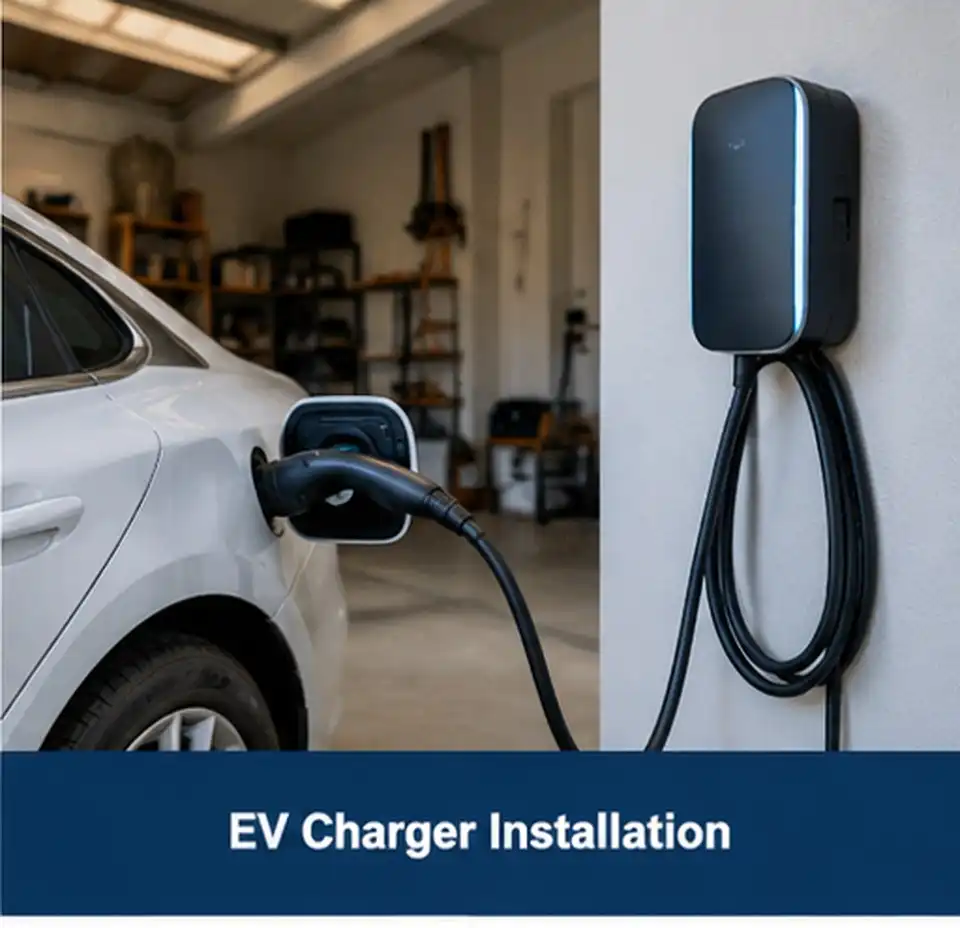
A Level 2 EV charger runs on a 240V circuit and adds roughly 20 to 40 miles of range per hour. EV chargers are considered continuous loads, so the circuit must be rated at 125% of the charger’s output. A 32A charger needs a 40A circuit. A 48A charger needs a 60A circuit.
This is where a good electric installation Huntsville AL plan pays off. On recent service calls across Madison County, we’ve found many 100A panels that cannot take a 60A charger on top of a heat pump. The fix may be a lower charger setting, a load management device, or a full panel upgrade.
| Charger Option | Circuit | Pros | Cons |
|---|---|---|---|
| Hardwired 32A | 40A dedicated | Fits many existing panels | Slower charging |
| Hardwired 48A | 60A dedicated | Fastest home charging | Often needs panel upgrade |
| NEMA 14-50 plug-in | 50A, GFCI required | Portable charger compatibility | Receptacle wear, GFCI cost |
| Load-managed charger | Shares capacity | Avoids service upgrade | Charging slows during peak use |
Our EV charger installation service starts with the same load calculation we use for panels. Check your vehicle’s onboard charger rating before choosing a unit, because a 48A charger won’t speed up a car that accepts only 32A.
Generator Hookups for Storm Season
Spring storms and summer outages are part of life in North Alabama. A generator keeps your refrigerator, well pump, medical devices, and HVAC fan running. It must connect through a transfer switch or a listed interlock kit. Without one, the generator can backfeed utility lines and injure line workers.
Never plug a generator into a dryer outlet with a double-male cord. That shortcut kills people every year.
Standby vs. Portable Generators
| Feature | Portable + Interlock | Whole-Home Standby |
|---|---|---|
| Fuel | Gasoline or dual-fuel | Natural gas or propane |
| Start | Manual | Automatic |
| Coverage | Selected circuits | Whole home or managed loads |
| Runs central AC? | Rarely | Yes, if sized correctly |
| Upfront cost | Lower | Higher |
| Permit | Usually required | Required (electrical and often gas) |
Running a central AC compressor on backup power requires enough starting current. A soft-start kit on the condenser can cut inrush current enough to let a smaller generator handle it. Before you buy, list the exact appliances you need to run during an outage.
Smart Home Wiring
Smart switches, video doorbells, and Wi-Fi thermostats all need steady power. Many smart switches require a neutral wire in the switch box. Older homes often lack it. Most smart thermostats need a C-wire (common wire), which supplies continuous 24V power from the HVAC transformer.
| Smart Device | Power Need | Common Issue |
|---|---|---|
| Smart switch / dimmer | Neutral in switch box | No neutral in pre-1985 homes |
| Smart thermostat | 24V C-wire | Only 4 wires run to the wall |
| Video doorbell | 16V to 24V transformer | Undersized doorbell transformer |
| Smart smoke/CO alarm | 120V interconnected | Mixing brands breaks interconnection |
| Energy monitor | CT clamps in panel | Requires live panel work |
If your thermostat cable has an unused wire tucked behind the wall, it can often serve as a C-wire. Check behind your current thermostat before buying an adapter kit.
HVAC and Electrical Coordination
HVAC systems are the largest electrical load in most North Alabama homes. They’re also the most common source of coordination mistakes. If you’ve spent a summer in Huntsville, understanding your control wiring makes complete sense. The thermostat sends a 24V signal, a contactor closes, and the compressor pulls high current at 240V.
Every electric installation Huntsville AL homeowners plan around HVAC should follow the equipment nameplate. The MCA sets the minimum wire size. The MOP sets the largest breaker allowed. A disconnect must be installed within sight of the outdoor unit.
Control Wire Functions
| Terminal | Wire Color (common) | Function |
|---|---|---|
| R / Rh / Rc | Red | 24V power from the transformer |
| C | Blue or black | Common, completes the 24V circuit |
| W / W1 | White | Heat call (furnace or heat strips) |
| W2 / AUX | Brown or other | Second-stage or auxiliary heat |
| Y / Y1 | Yellow | Cooling call, energizes compressor contactor |
| Y2 | Light blue or other | Second-stage cooling |
| G | Green | Indoor blower fan |
| O/B | Orange or dark blue | Heat pump reversing valve |
Colors are conventions, not rules. Always verify by the terminal label at both the thermostat and the air handler.
Thermostat vs. Furnace Relays
| Component | Voltage | Role | Common Failure |
|---|---|---|---|
| Thermostat | 24V | Sends call for heat, cool, or fan | Dead batteries, loose wire, no C-wire |
| Control board relays | 24V coil | Switch blower and inducer | Burned relay contacts |
| Condenser contactor | 24V coil, 240V contacts | Starts compressor and outdoor fan | Pitted contacts, ant nests |
| Blower motor | 120V or 240V | Moves air through ducts | Failed capacitor, worn bearings |
| Heat strip sequencer | 24V signal, 240V load | Stages electric heat | Burned elements, tripped limit |
HVAC-Electrical Coordination Checklist
| Checkpoint | What We Verify | Why It Matters |
|---|---|---|
| Nameplate MCA | Wire gauge meets or exceeds it | Prevents overheated cable |
| Nameplate MOP | Breaker does not exceed it | Protects compressor windings |
| Outdoor disconnect | Within sight, weather-rated | Required for safe service |
| Air handler circuit | Sized for heat strips | Prevents winter breaker trips |
| Surge protection | Whole-home SPD at panel | Protects inverter boards from lightning |
| Thermostat C-wire | Present and terminated | Stable smart thermostat power |
| Condensate safety switch | Wired into 24V circuit | Shuts system off before water damage |
| Panel capacity | Load calculation updated | Prevents service overload |
| GFCI rules for outdoor equipment | Matches local code adoption | Avoids nuisance trips on inverter units |
Inverter heat pumps contain sensitive electronics, so whole-home surge protection now carries extra weight. Some recent code editions also extended GFCI protection to outdoor outlets that serve HVAC equipment. That change caused nuisance tripping on certain inverter units. Ask your electrician how your jurisdiction currently applies that rule.
Steps to Troubleshoot an AC That Won’t Start After an Electrical Change
- Check the thermostat for power and correct mode.
- Check the breakers for both the condenser and the air handler.
- Inspect the outdoor disconnect and confirm the pull-out is seated.
- Look at the condensate float switch for a full drain pan.
- Listen at the condenser for a contactor click.
- Stop and call if you smell burning or see scorched wires.
Steps 1 through 4 are safe for homeowners. Anything inside the condenser panel involves 240V and stored capacitor charge.
Safety Guidelines for Every Installation
Electrical safety starts with recognizing when a problem is urgent. Loose connections generate heat long before a breaker trips. Service conductors in your panel stay energized even with the main breaker off.
Safety Standards Comparison
| Protection | Protects Against | Where Typically Required | How to Test |
|---|---|---|---|
| GFCI | Shock from ground faults | Wet and damp locations | TEST button monthly |
| AFCI | Fires from arcing faults | Most living spaces, kitchens, laundry | TEST button on breaker |
| Tamper-resistant receptacles | Child shock injuries | All new dwelling receptacles | Visual (shutters) |
| Whole-home SPD | Surges and lightning spikes | New and replaced services | Indicator light |
| Outdoor emergency disconnect | First-responder access | New and replaced services | Visual |
| Interconnected smoke alarms | Fire detection | New construction and remodels | Monthly test |
| CO alarms | Carbon monoxide poisoning | Homes with fuel appliances or attached garages | Monthly test |
The National Fire Protection Association publishes the National Electrical Code (NFPA 70) along with homeowner fire safety guidance. Its research shows electrical distribution and lighting equipment remain a leading cause of home fires.
Home Electrical Safety Checklist
- Test all GFCI and AFCI devices monthly
- Keep 36 inches of clear space in front of the panel
- Label every breaker accurately
- Replace any warm, cracked, or discolored outlet
- Never use extension cords as permanent wiring
- Keep generators at least 20 feet from doors and windows
- Install surge protection before lightning season
Stop and Call Right Away If You Notice
- A burning or hot-plastic smell from an outlet or panel
- Sparks, smoke, or scorch marks
- A hot or buzzing breaker panel
- Tingling from fixtures, faucets, or appliances
- Water reaching outlets, cords, or the panel
For any of these, turn off the circuit if it’s safe, and reach our emergency electrician service. If there’s fire or smoke, leave the house and call 911 first.
NEC and Permit Requirements in North Alabama
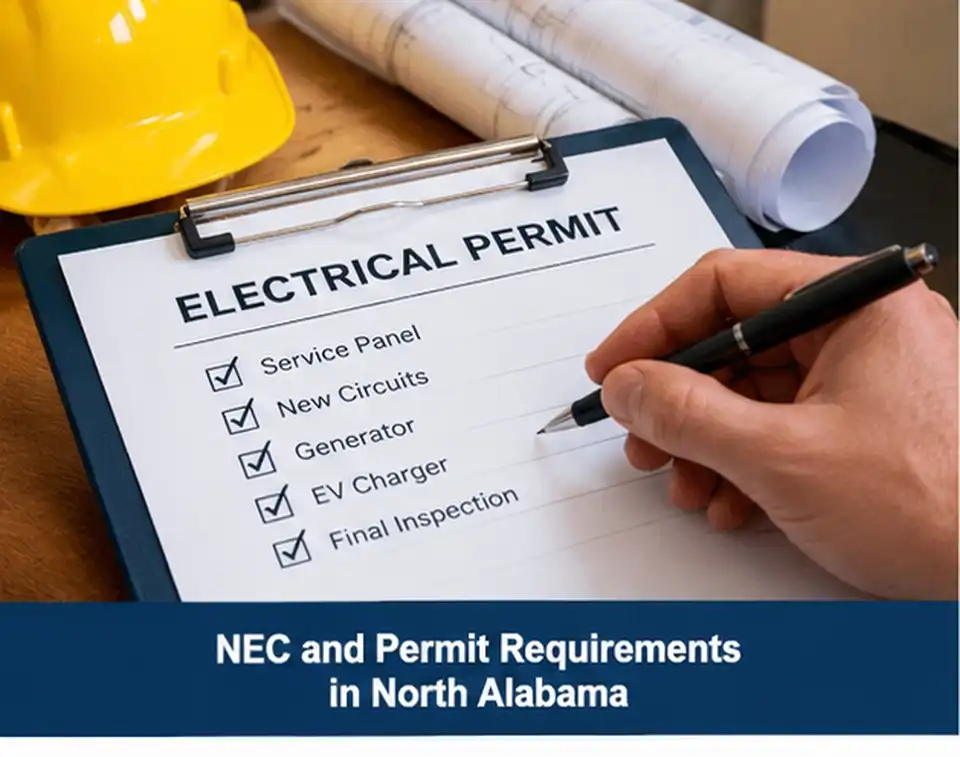
The National Electrical Code (NEC, also called NFPA 70) sets the minimum standard for safe wiring. NFPA updates it every three years. Each city or county adopts an edition on its own schedule, sometimes with local amendments. Huntsville, Madison, Decatur, and Athens each run their own inspections. Unincorporated areas fall under county rules.
A properly permitted electric installation Huntsville AL inspectors sign off on protects you in three ways. It confirms code compliance, it keeps your homeowner’s insurance valid, and it prevents problems at resale.
Installation Types vs. Permit Requirements
| Installation | Permit Usually Required? | Inspection |
|---|---|---|
| Panel replacement or upgrade | Yes | Yes, plus utility coordination |
| New circuit (any size) | Yes | Yes |
| Home rewiring | Yes | Rough-in and final |
| EV charger (new circuit) | Yes | Yes |
| Generator with transfer switch | Yes | Yes |
| HVAC replacement (new circuit) | Yes | Yes |
| Hot tub or pool wiring | Yes | Yes, including bonding |
| Like-for-like outlet or switch swap | Usually no | No |
| Light fixture replacement on existing box | Usually no | No |
| Smart thermostat swap (low voltage) | Usually no | No |
Requirements vary by jurisdiction, so confirm with your local inspections office or your electrician. Ask for the permit number before work begins.
How to Verify Your Electrician
- Ask for the Alabama license number.
- Check it with the Alabama Electrical Contractors Board.
- Request proof of liability insurance.
- Confirm who pulls the permit.
- Get the price in writing, with what’s included.
Where We Install: Huntsville and North Alabama Communities
We serve homeowners across seven counties. Coverage is confirmed by phone before anything is scheduled. Rural addresses near listed towns are often included.
| County | Communities Served |
|---|---|
| Madison | Huntsville, Madison, Hazel Green, Meridianville, Toney, New Market, Gurley, Owens Cross Roads, New Hope |
| Limestone | Athens, Elkmont, Mooresville |
| Morgan | Decatur, Hartselle, Trinity, Falkville, Lacey’s Spring |
| Lawrence | Moulton, Hillsboro, Town Creek |
| Marshall | Guntersville, Arab, Boaz, Grant, Union Grove |
| Jackson | Scottsboro, Hollywood, Langston, Section, Stevenson |
| DeKalb | Fort Payne, Geraldine, Henagar, Mentone, Valley Head |
Homes in the Tennessee Valley flatlands face different challenges than homes on Monte Sano or Lookout Mountain. Lakeside properties near Guntersville and Decatur need extra attention to moisture and bonding. Mountain homes often run long service drops and use well pumps.
FAQs
How long does a typical electric installation Huntsville AL project take?
A single circuit or fixture usually takes a few hours. A panel upgrade often takes one day of work plus utility coordination. A whole-home rewire can take several days, depending on access and home size.
Do I need a 200A panel for an EV charger?
Not always. A load calculation decides it. Many 100A and 150A panels can support a 40A charger circuit or a load-managed charger.
Can the HVAC company install the electrical circuit for my new heat pump?
HVAC contractors can connect equipment, but new branch circuits and panel work generally fall under a licensed electrician and need a permit. Coordinating both trades avoids mismatched breakers and failed inspections.
Why does my new smart thermostat keep shutting off?
It’s most likely missing a C-wire. Without steady 24V common power, the thermostat drains its battery or reboots. An electrician or HVAC tech can run a C-wire or use a spare conductor.
Is knob-and-tube wiring illegal in Alabama?
It isn’t automatically illegal if it was never modified. Still, it lacks a ground, can’t support GFCI/AFCI devices well, and many insurers will refuse coverage. We recommend replacement.
What should I ask before approving any electrical work?
Ask for the license number, proof of insurance, whether a permit is needed, the written price, and what will be tested before the job is complete.
Plan Your Next Installation the Right Way
Every safe installation starts with real numbers: your nameplates, your panel rating, and a load calculation. Our Gov Certified technicians look at the whole system rather than the single device on your wish list. That’s how a properly planned electric installation Huntsville AL homeowners invest in keeps running through August heat and January cold snaps.
From panel upgrades in Madison to rewiring in Decatur and EV chargers in Athens, we bring the same safety-first process to every home. Clear diagnosis comes first, then clear pricing, then code-compliant work. Write down your three biggest electrical loads and your panel’s main breaker rating, then call Huntsville AL Electricians at (855) 321-3149 to schedule your load assessment.