
Trace the Fault: Electrical Troubleshooting And Repairs Huntsville AL
A breaker that trips every July afternoon is rarely random. It is usually your heat pump, an overloaded circuit, or a loose connection telling you something under heavy summer load. Smart electrical troubleshooting and repairs Huntsville AL homeowners can trust start with that pattern, not with guesswork. The difference matters. A correct diagnosis fixes the cause once. A wrong one replaces parts while the real fault keeps heating up behind your walls.
The Quick Read: 3 Things Every Huntsville Homeowner Should Know
- Reset once, then stop. A breaker or GFCI that trips again right away signals a real fault. Repeated resets can turn a small problem into overheated wiring.
- Your HVAC and electrical systems share the blame. Many “AC problems” in North Alabama are actually 24-volt control wiring, a tripped float switch, or an undersized breaker.
- Burning smells, hot panels, and sparks are emergencies. Shut off the circuit if it is safe, leave if there is smoke, and call 911 first for fire.
Why Electrical Faults Hit North Alabama Homes Harder
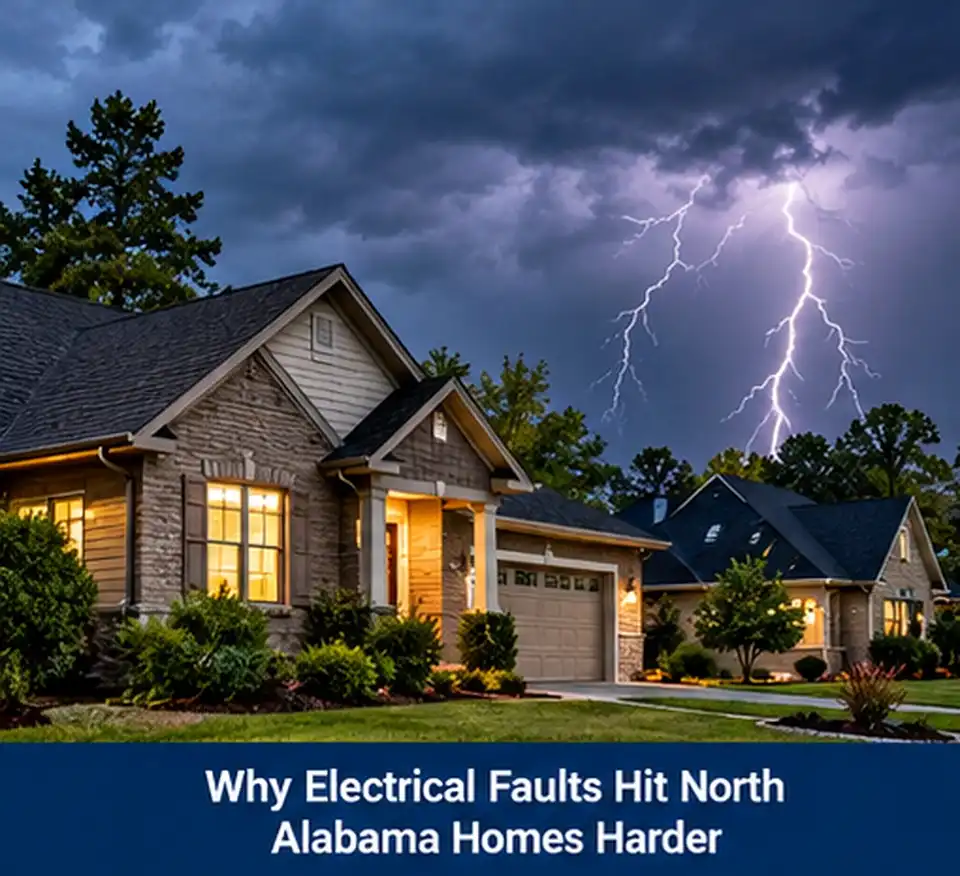
North Alabama’s climate puts extra stress on home electrical systems. High humidity, long cooling seasons, and spring thunderstorms all push wiring, panels, and HVAC equipment harder than milder regions do. Our Gov Certified technicians frequently see this in North Alabama homes: a system works fine in April, then fails during the first 95°F week in June.
Heat and moisture are the main drivers. Moisture corrodes outdoor receptacles and disconnects. Heat loosens terminal connections through repeated expansion and contraction. Lightning surges damage control boards and smart thermostats. If you’ve spent a summer in Huntsville, understanding your control wiring makes complete sense.
| North Alabama Stress Factor | What It Does to Your System | Where We Find the Damage |
|---|---|---|
| Summer humidity (often 70%+) | Corrodes terminals, trips GFCIs | Outdoor outlets, garages, crawl spaces |
| Long cooling season | Sustained high amperage on HVAC circuits | Condenser disconnects, panel lugs |
| Spring and summer storms | Voltage spikes and surge damage | Thermostats, HVAC boards, electronics |
| Attic heat (130°F+) | Degrades insulation, loosens splices | Attic junction boxes, fan wiring |
| Rodents | Chewed cable jackets, exposed conductors | Attics, basements, crawl spaces |
| Older housing stock | Ungrounded wiring, outdated panels | 1950s to 1970s neighborhoods |
Good electrical troubleshooting and repairs Huntsville AL families rely on account for these local patterns before anyone touches a tool. Start by noting when the problem happens: time of day, weather, and which appliances were running.
Common Fault Diagnosis: Symptoms, Causes, and Urgency
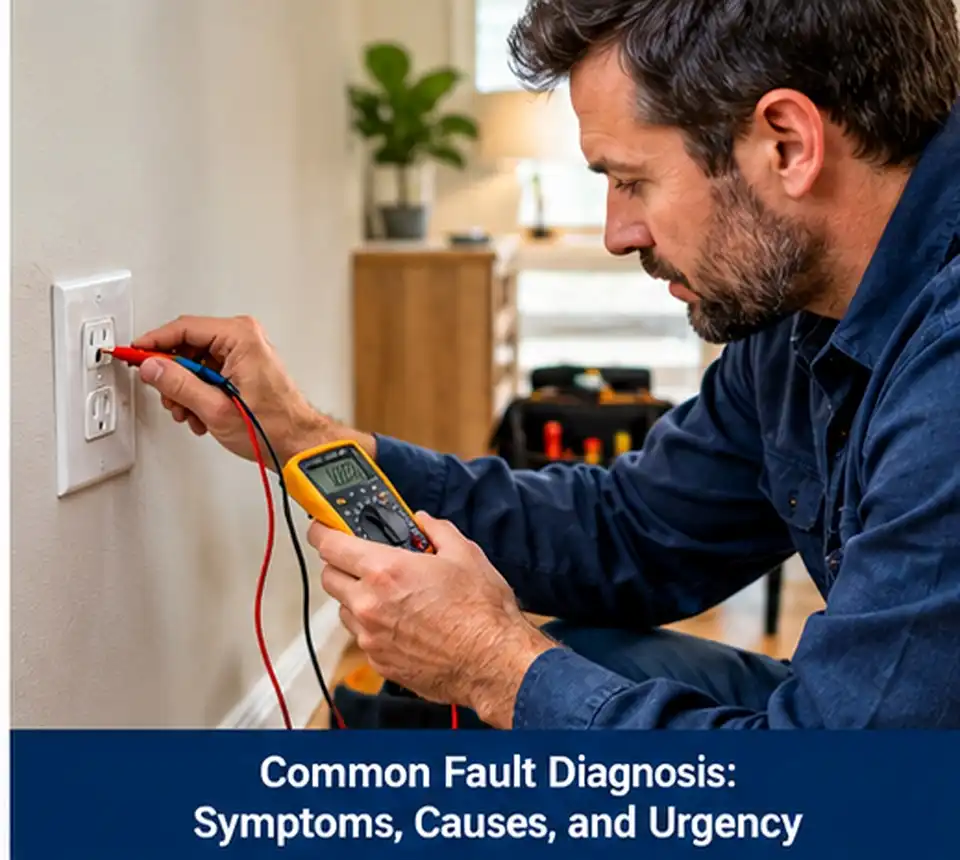
Every electrical symptom points to a short list of causes. On recent service calls across Madison County, the same handful of faults accounts for most of our visits. Knowing the list helps you describe the problem clearly and judge how fast you need help.
Common Faults and Causes
| Symptom | Most Likely Causes | Urgency | Safe Homeowner Check |
|---|---|---|---|
| Breaker keeps tripping | Overloaded circuit, short, ground fault, worn breaker | Soon | Unplug loads, reset once |
| Flickering lights (one fixture) | Loose bulb, incompatible dimmer | Low | Swap bulb, test another bulb |
| Flickering lights (whole house) | Loose service connection, utility issue | Soon to urgent | Call your utility and an electrician |
| Dead outlet | Tripped GFCI upstream, loose backstab connection | Soon | Check GFCIs, breakers, wall switches |
| Warm or discolored outlet | Loose terminal, overloaded receptacle | Urgent | Stop using it, shut off breaker |
| Burning or fishy smell | Overheating device or wire | Emergency | Shut off circuit if safe, call now |
| Half the house dark | Lost utility leg, failed main breaker | Urgent | Check main breaker, call utility |
| Lights brighten when appliances start | Open neutral | Emergency | Turn off main if safe, call now |
| Buzzing panel | Loose lug, failing breaker | Urgent | Do not open the panel cover |
| Tingling from faucet or fixture | Ground fault, missing bonding | Emergency | Avoid contact, shut off power |
Steps to Troubleshoot Before You Call
You can safely check a few things yourself. Anything beyond these steps belongs to a licensed electrician.
- Identify the scope. Note whether one outlet, one room, or the whole house is affected.
- Check every GFCI. Kitchens, baths, garages, and exterior outlets often share one GFCI that controls several others.
- Inspect the breaker panel. Look for a handle sitting in the middle position. Push it fully OFF, then ON.
- Unplug the suspected load. Space heaters, window units, and hair dryers cause most overloads.
- Reset only once. If the breaker trips again immediately, leave it off.
- Write down the pattern. Time, weather, and running appliances help your technician find the fault faster.
When these steps do not solve it, a systematic fault-finding visit uses meters and load testing to trace problems you cannot see. That is the core of professional electrical troubleshooting and repairs Huntsville AL homeowners need for intermittent faults. For straightforward failures, our dead outlet, switch, and circuit repairs get the issue fixed and tested in one visit.
Voltage Breakdown: What Your Home Actually Runs On
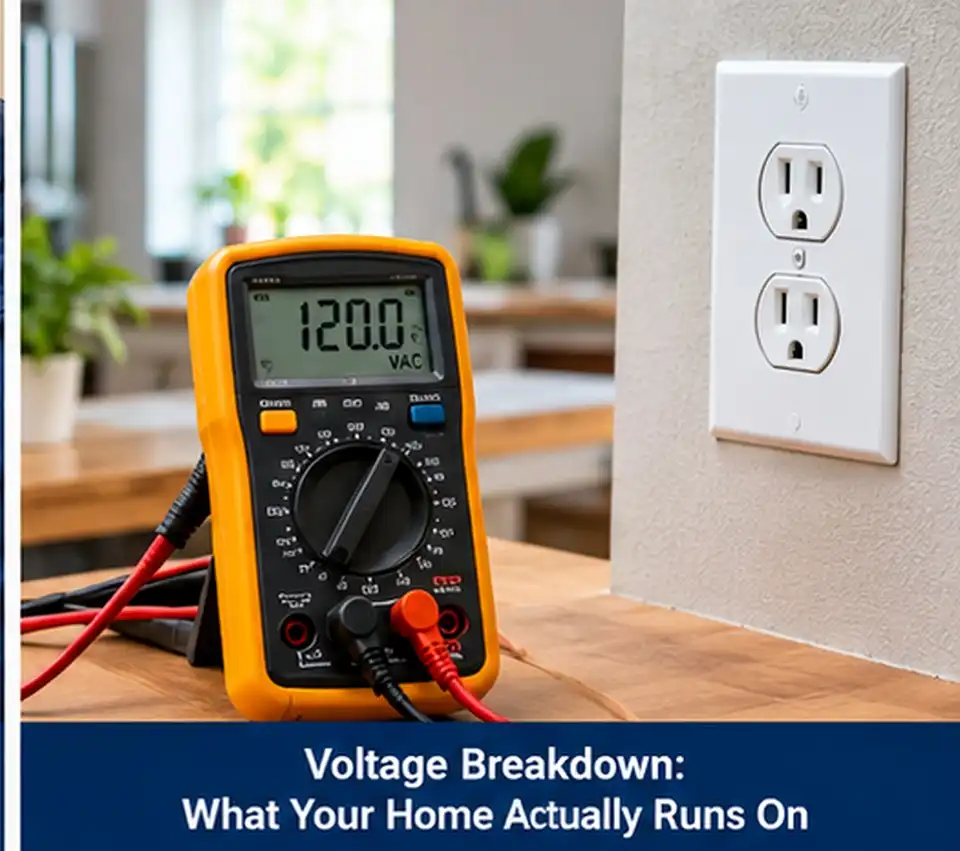
Your home runs on split-phase 120/240-volt power. Two 120-volt “legs” enter from the utility. Lights and outlets use one leg (120V). Large appliances like dryers, ranges, and heat pumps use both legs together (240V).
Voltage should stay within a tight window. The industry standard (ANSI C84.1) sets a normal service range of plus or minus 5 percent. Readings outside that range point to utility problems, loose connections, or a failing neutral.
| System | Nominal Voltage | Normal Range | What Runs On It | Red Flag Reading |
|---|---|---|---|---|
| General circuits | 120V | 114V to 126V | Lights, outlets, small appliances | Below 110V or above 130V |
| Large appliance circuits | 240V | 228V to 252V | Heat pumps, dryers, ranges, water heaters | Uneven legs, below 220V |
| HVAC control circuit | 24V AC | About 24V to 28V | Thermostat, relays, contactor coil | 0V (blown fuse or open switch) |
| Doorbell circuit | 16V to 24V AC | Varies by transformer | Doorbells, video doorbells | Weak chime, rebooting camera |
| Landscape lighting | 12V AC | 10.5V to 12.5V at fixture | Path and garden lights | Dim fixtures at end of run |
We inspect voltage at the panel and at the device. A big drop between the two reveals voltage drop from long runs, undersized wire, or a corroded splice. Our crews frequently find this on detached garages and workshops fed by long underground runs.
Lights that get much brighter when a large appliance starts signal an open neutral. That condition can send up to 240 volts through 120-volt devices. Treat it as an emergency and request urgent electrical help right away.
GFCI and AFCI Protection Standards
GFCIs and AFCIs protect against two different dangers. A GFCI (ground-fault circuit interrupter) protects people from shock. An AFCI (arc-fault circuit interrupter) protects the house from fires caused by arcing wires. Many circuits now need both.
AFCI vs. GFCI Comparison
| Feature | GFCI | AFCI | Dual-Function (CAFCI/GFCI) |
|---|---|---|---|
| Protects against | Electric shock | Arcing that starts fires | Both |
| How it works | Detects current leakage (about 5 milliamps) | Detects abnormal arc patterns | Combines both sensors |
| Typical locations | Kitchens, baths, garages, outdoors, laundry | Bedrooms, living areas, hallways, closets | Kitchens and laundry rooms |
| Common nuisance trips | Moisture, failing appliances, motors | Shared neutrals, old motors, loose splices | Either cause |
| Monthly test | Press TEST, then RESET | Press TEST on breaker | Press TEST |
| Device format | Receptacle or breaker | Breaker or receptacle | Breaker or receptacle |
The NFPA explains that AFCIs are designed to sense abnormal arcing conditions in home wiring before that arcing ignites nearby materials. That matters in older North Alabama homes where brittle insulation and loose splices are common.
Where Recent Code Editions Require GFCI Protection
| Location | GFCI Required? | Notes from the Field |
|---|---|---|
| Bathrooms | Yes | All receptacles |
| Kitchens | Yes | Recent NEC editions expanded beyond countertops |
| Garages and accessory buildings | Yes | Includes freezer and opener outlets in newer code |
| Outdoors | Yes | Must have weatherproof “in-use” covers |
| Basements and crawl spaces | Yes | Sump pumps included under newer rules |
| Laundry areas | Yes | Washer receptacles included |
| Within 6 feet of any sink | Yes | Wet bars and utility sinks count |
| Outdoor HVAC equipment | Yes (2020 NEC and later) | Can cause nuisance trips with some inverter heat pumps |
Code adoption varies by city and county. We confirm requirements with the local building department before any permitted work. Proper electrical troubleshooting and repairs Huntsville AL inspectors will approve always match the locally adopted code edition.
Pros of upgrading to AFCI/GFCI protection:
- Reduces fire risk from hidden arcing in walls
- Prevents shock in wet areas
- Supports insurance and resale inspections
- Flags wiring defects you did not know existed
Cons to plan for:
- Nuisance trips on circuits with old motors or shared neutrals
- Higher device cost than standard breakers
- Older panels may not accept compatible breakers
Test every GFCI and AFCI this month: press TEST, confirm power cuts off, then press RESET.
Panel Troubleshooting: When the Heart of the System Struggles
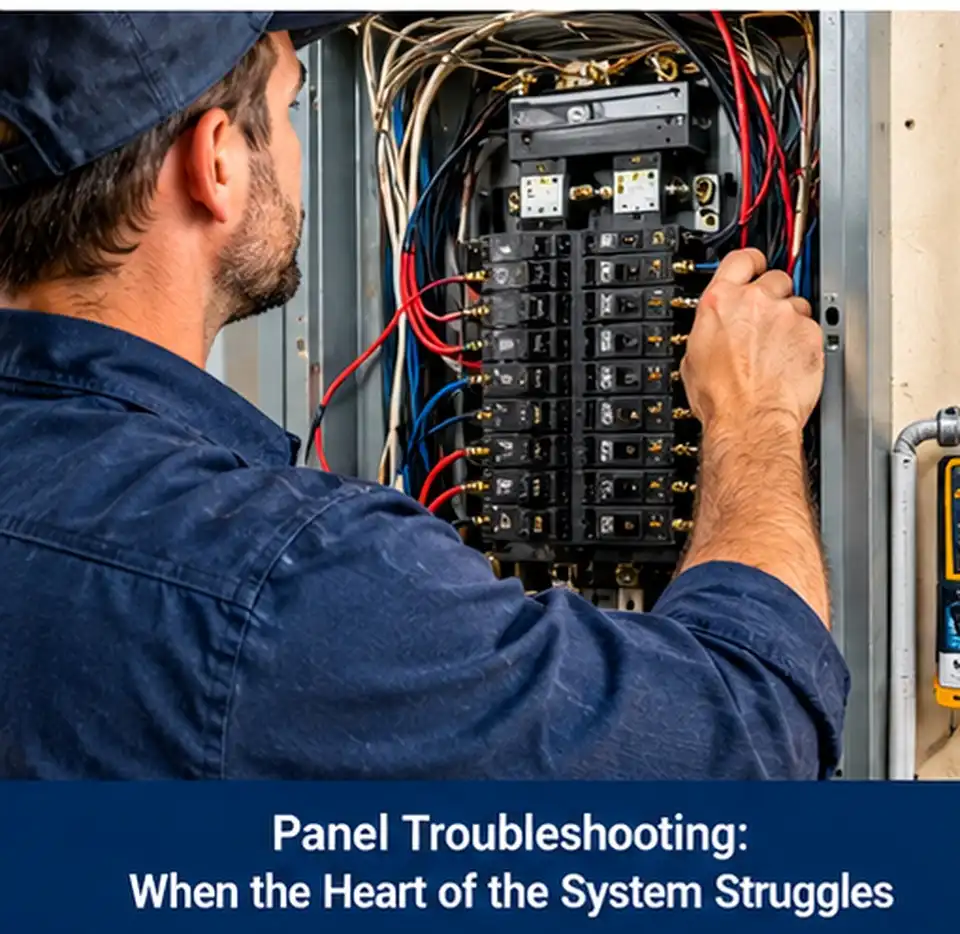
Your breaker panel distributes every amp in the house. When it fails, symptoms show up everywhere: tripping, flickering, warm breakers, and buzzing. Service conductors stay energized even with the main breaker off, so panel work is never a DIY job.
Panel Warning Signs
| Warning Sign | What It Usually Means | Recommended Action |
|---|---|---|
| Panel cover warm to the touch | Overloaded breakers or loose lugs | Urgent inspection |
| Buzzing or crackling | Arcing at a breaker or bus bar | Urgent inspection |
| Scorch marks or melted plastic | Active overheating | Emergency shutoff and call |
| Breakers that won’t stay reset | Circuit fault or worn breaker | Diagnosis and repair |
| Rust or water stains inside | Moisture intrusion | Repair source, inspect panel |
| Federal Pacific, Zinsco, or Challenger label | Known problem-brand equipment | Replacement evaluation |
| No open slots, many tandem breakers | Panel at capacity | Capacity upgrade evaluation |
| 100-amp service with heat pump + EV | Undersized service | Load calculation |
Our Gov Certified technicians frequently see Federal Pacific Stab-Lok and Zinsco panels in homes built from the 1950s through the 1980s. These brands have documented histories of breakers failing to trip under overload. If your home has one, replacing a problem-brand panel removes that risk entirely.
Capacity is the other common issue. Modern homes add heat pumps, EV chargers, induction ranges, and home offices. A 100A to 200A service upgrade gives you room for those loads without constant tripping. We always run an NEC load calculation first, so you never pay for capacity you do not need.
Repair vs. Replace: Panel Decision Guide
| Factor | Repair Makes Sense | Replacement Makes Sense |
|---|---|---|
| Panel age | Under 25 years | 30+ years |
| Brand | Major current brand | Federal Pacific, Zinsco, Challenger |
| Damage | One worn breaker or loose lug | Burned bus bar, widespread corrosion |
| Capacity | Open slots available | Full panel, adding major loads |
| Insurance | No insurer concerns | Insurer flags the panel |
Check your panel label today and note the brand, amperage, and open slots before you call.
HVAC and Electrical Integration: Heat Pumps and Control Wiring
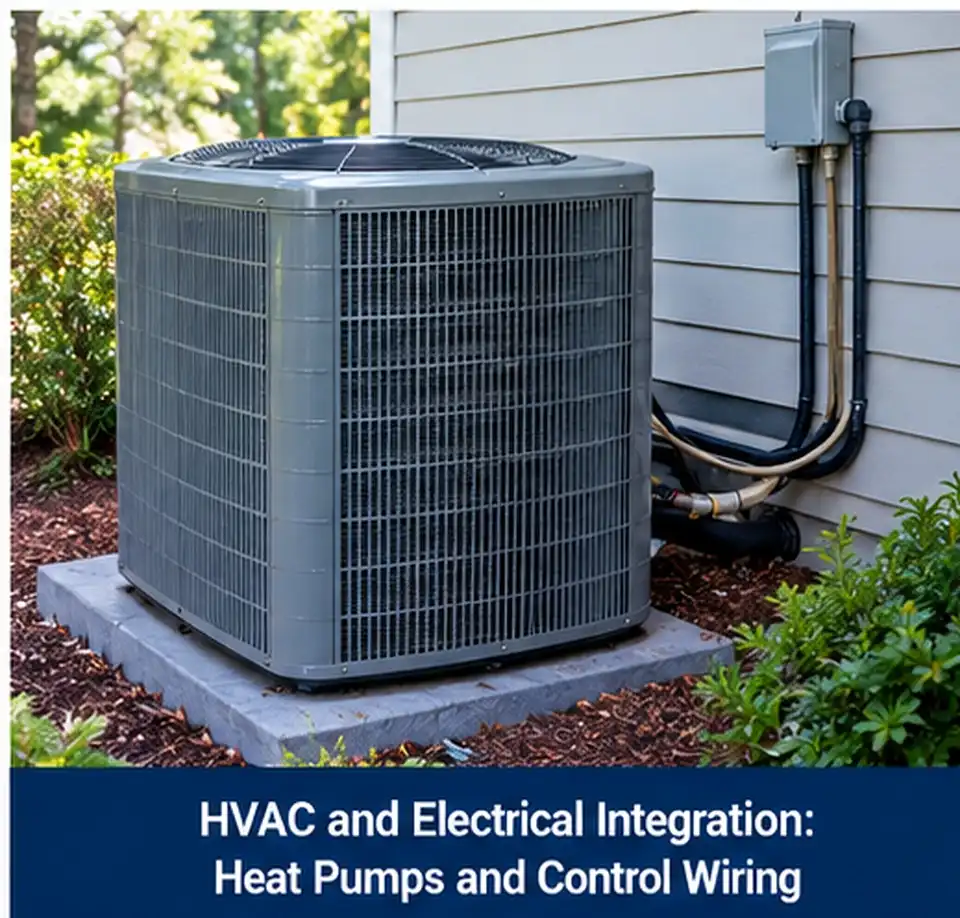
Your HVAC system is an electrical system. It draws 240 volts for the compressor and air handler, then relies on a 24-volt control circuit to tell each part when to run. Many “the AC is broken” calls in Huntsville turn out to be electrical faults, not refrigerant problems.
Heat pumps dominate North Alabama homes because our winters are mild. The U.S. Department of Energy notes that heat pumps use electricity to transfer heat rather than create it, which makes them far more efficient than traditional systems. That efficiency only holds if the breaker sizing, disconnect, and control wiring are correct.
Control Wire Functions
| Terminal | Typical Wire Color | Function | Common Failure Symptom |
|---|---|---|---|
| R / Rh / Rc | Red | 24V power from transformer | Thermostat blank, nothing runs |
| C | Blue or black | 24V common (return path) | Smart thermostat reboots or goes dark |
| Y / Y1 | Yellow | Calls compressor (cooling) | Fan runs, no cooling |
| Y2 | Light blue | Second-stage compressor | Short cycles on hot days |
| G | Green | Indoor blower fan | Outdoor unit runs, no airflow |
| O/B | Orange or dark blue | Reversing valve (heat pump) | Blows cold air in heat mode |
| W / W1 / AUX | White | Heat or auxiliary strip heat | High winter bills, no backup heat |
| E | Varies | Emergency heat | Strips run constantly |
Wire colors are conventions, not rules. We always verify at both the thermostat and the air handler board before changing anything.
Thermostat vs. Air Handler and Furnace Relays
| Component | What It Controls | Voltage | Who Typically Services It |
|---|---|---|---|
| Thermostat | Sends calls for heat, cool, fan | 24V | Electrician or HVAC tech |
| Control board / fan relay | Switches the blower motor | 24V coil, 120V/240V load | HVAC tech |
| Transformer (often 40VA) | Steps 120V/240V down to 24V | 120V/240V in, 24V out | Electrician or HVAC tech |
| Contactor (outdoor unit) | Switches compressor and fan power | 24V coil, 240V load | HVAC tech |
| Heat strip sequencers | Stages electric backup heat | 24V coil, 240V load | HVAC tech |
| Disconnect and breaker | Feeds power to the equipment | 240V | Electrician |
HVAC Electrical Coordination: Who Handles What
| Problem | Electrical Side | HVAC Side |
|---|---|---|
| Breaker trips when AC starts | Verify breaker matches MOCP on nameplate, check wire size | Test capacitor, compressor amp draw |
| Thermostat goes blank | Check transformer power and breaker | Check float switch and blown 3A or 5A board fuse |
| New smart thermostat won’t power on | Add C-wire or adapter | Confirm board compatibility |
| Outdoor GFCI trips the heat pump | Evaluate GFCI type and code requirements | Check inverter drive leakage current |
| Burned disconnect | Replace disconnect and whip | Inspect unit terminals |
| Lightning damage | Install whole-house surge protection | Replace control board |
The condensate float switch deserves special mention. On recent service calls across Madison County, a clogged drain line tripped the float switch, which cut 24V power and shut down the system. Homeowners thought the unit had died. Our humid summers produce gallons of condensate every day, so a clogged line is common.
Check the nameplate on your outdoor unit and note the MCA (minimum circuit ampacity) and MOCP (maximum overcurrent protection). Your breaker must not exceed the MOCP number. This single check is part of thorough electrical troubleshooting and repairs Huntsville AL HVAC owners often skip.
Safety Checklists for North Alabama Homeowners
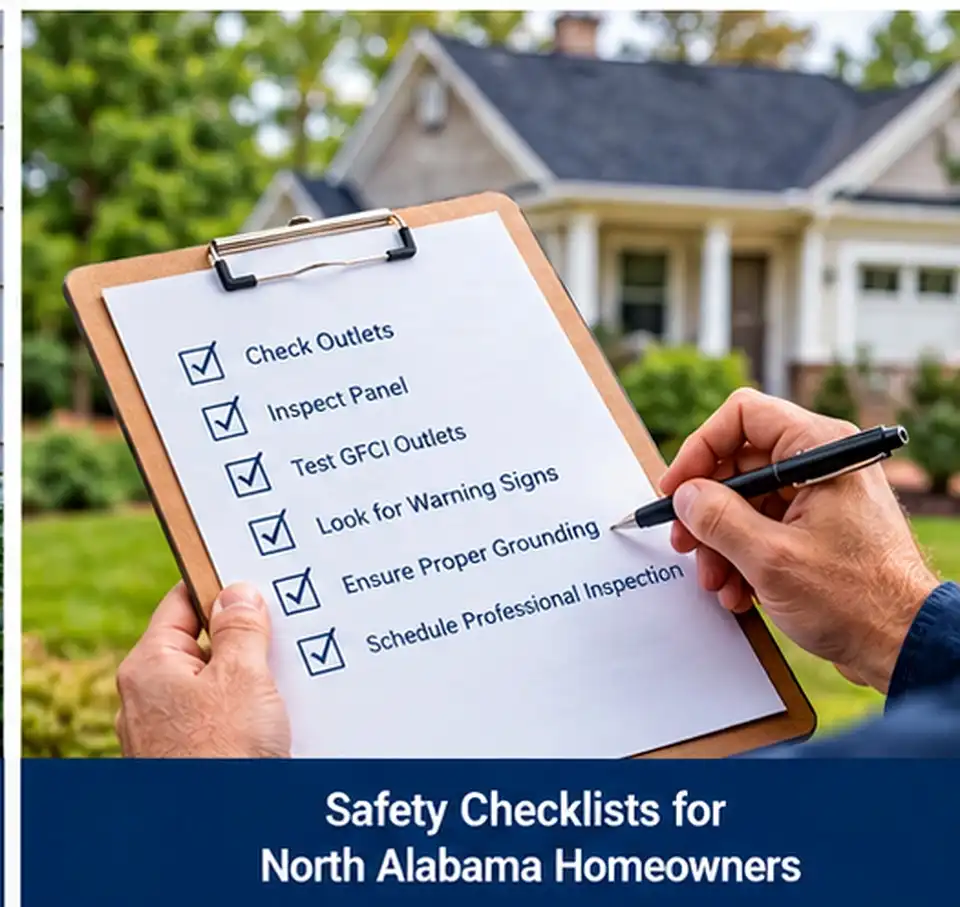
Electrical safety follows a simple rule: protect people first, property second. These checklists cover what to do in an emergency and how to prevent problems through the year.
Stop and Call Right Away If You Notice
- A burning, hot-plastic, or fishy smell from an outlet, switch, or panel
- Sparks, smoke, or scorch marks on any device
- A panel or breaker that is hot or buzzing loudly
- Tingling or shocks from fixtures, appliances, or faucets
- Water reaching outlets, cords, or the panel
- Lights that suddenly get much brighter in some rooms
Fire, smoke, or a downed line? Leave the house and call 911 first. Stay at least 35 feet from downed lines and report them to your utility.
What Never to Do
- Never tape a breaker handle in the ON position
- Never replace a breaker with a larger amp rating to stop tripping
- Never remove the ground pin from a plug
- Never run a portable generator without a transfer switch or interlock
- Never open the panel dead front (the inner cover)
Seasonal Electrical Checklist
| Season | Task | Why It Matters in North Alabama |
|---|---|---|
| Spring | Test GFCIs and AFCIs | Storm season brings water and surges |
| Spring | Check outdoor receptacle covers | Heavy rain corrodes exposed outlets |
| Early summer | Clear condensate drain, test float switch | Prevents mid-July shutdowns |
| Summer | Watch for warm outlets or panel | Peak cooling load stresses connections |
| Fall | Test heat strips and emergency heat | Catches failures before the first freeze |
| Fall | Inspect attic wiring for rodent damage | Rodents move indoors as temps drop |
| Winter | Avoid space heaters on shared circuits | Top cause of winter overloads |
| Year-round | Test smoke and CO alarms monthly | Hardwired alarms still need checks |
Put a monthly reminder on your phone to test GFCIs, AFCIs, and alarms on the same day.
What to Expect from a Professional Service Visit
A professional visit follows a clear sequence. You should know what happens before anyone opens a cover. At Huntsville AL Electricians, we connect you with licensed local electricians who explain the cause before work begins.
- Describe the problem by phone: symptom, timing, and what you noticed.
- Get triage guidance on whether it is urgent and how scheduling works for your address.
- Receive on-site diagnosis with meters, load tests, and visual inspection.
- Review the repair options and the price before you approve anything.
- Confirm completion and testing, with permits and inspections where required.
Before work starts, ask for the electrician’s Alabama license number and proof of insurance. You can verify the license with the Alabama Electrical Contractors Board. Transparent electrical troubleshooting and repairs Huntsville AL providers welcome these questions.
| Question to Ask | Why It Matters |
|---|---|
| What is your Alabama license number? | Confirms legal authority to do the work |
| Is a permit required? | Panels, new circuits, and generators usually need one |
| What does the price include? | Avoids surprise charges for parts or testing |
| What will you test before leaving? | Proves the fix actually worked |
| Can you look at other issues while here? | Combines small jobs into one visit |
FAQs
Why does my breaker trip only in summer?
Summer trips usually mean overload from cooling equipment. Your heat pump draws its highest current on the hottest days. A worn breaker, loose connection, or weak capacitor can push it past the limit.
Is a warm outlet dangerous?
Yes. A warm outlet signals a loose terminal or overloaded receptacle. Stop using it, turn off the breaker, and schedule a repair soon.
Can I install a smart thermostat myself?
You can if your system already has a C-wire and you follow the manufacturer’s instructions. Many older Huntsville homes lack a C-wire. Incorrect wiring can blow the control board fuse or damage the thermostat.
How often should I test GFCIs?
Test them monthly. Press TEST, confirm power cuts off, then press RESET. Replace any GFCI that fails to trip or won’t reset.
Do I need a panel upgrade for a heat pump or EV charger?
Not always. A load calculation decides it. Many 200-amp homes handle both, while many 100-amp homes need an upgrade.
What does it cost to use this service?
Connecting is free for homeowners. You pay the independent licensed provider directly, and electrical troubleshooting and repairs Huntsville AL pricing depends on what they find at your home.
Which communities do you serve?
We help homeowners across Madison, Limestone, Morgan, Lawrence, Marshall, Jackson, and DeKalb counties. That includes Huntsville, Madison, Decatur, Athens, Hartselle, Guntersville, Scottsboro, and Fort Payne.
Get the Fault Found and Fixed the First Time
The right diagnosis protects your home, your HVAC equipment, and your family. Every tripped breaker, warm outlet, and blank thermostat has a cause, and a licensed electrician can find it with the right tests. At Huntsville AL Electricians, we focus on safety-first diagnosis, clear explanations, and residential-only service across North Alabama. You get answers before any work begins.
Call Huntsville AL Electricians today and describe what is happening at your home. Whether you live in Huntsville, Madison, Decatur, Athens, or a rural address nearby, one call connects you with Gov Certified expert electrical services and clear next steps.