
How to Dim LED Lights Without a Dimmer Switch in Huntsville
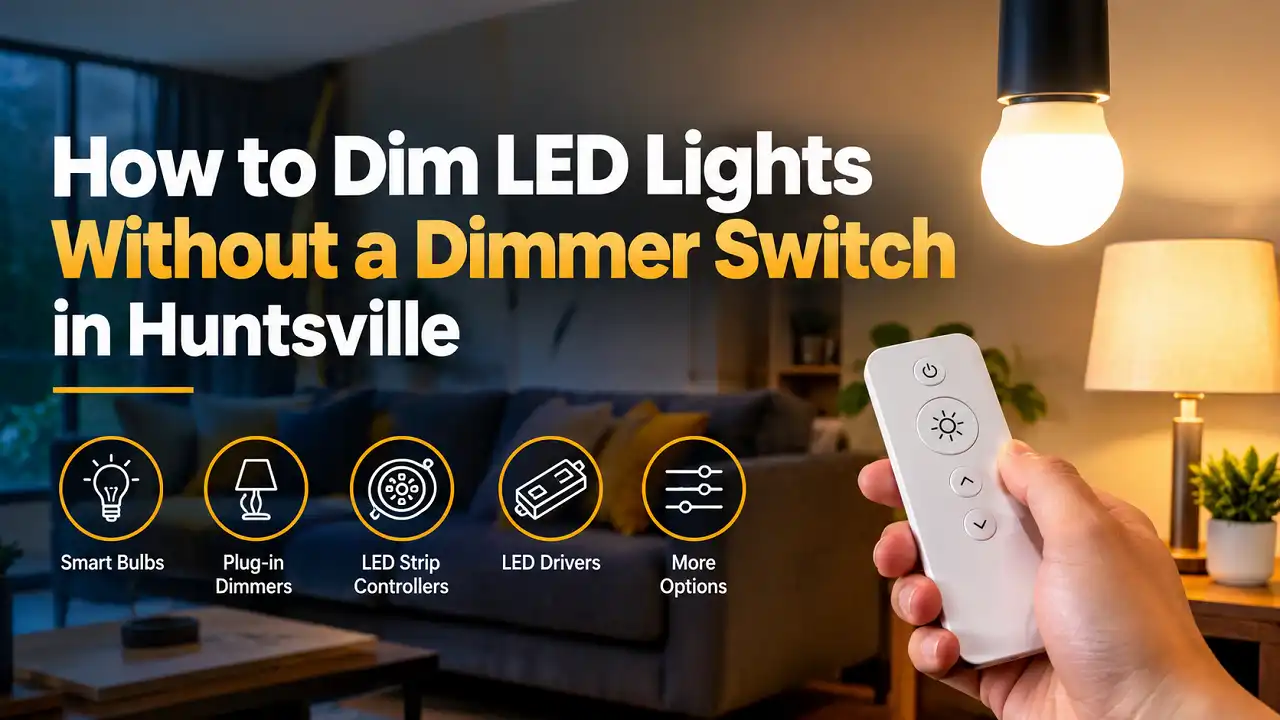
Bright LEDs save energy, but they can make a living room feel like an operating room. Learning how to dim LED lights without a dimmer switch gives you softer light, better evening comfort, and no need to open a wall box. The best method depends on your bulb type, your fixture, and the wiring already behind your switch. Pick the wrong one and you get flicker, buzzing, or a dead bulb in two weeks.
Quick Wins for Your Home
- Smart bulbs and plug-in lamp dimmers are the fastest no-wiring fixes. Both work with a standard on/off switch left in the “on” position.
- Lower-lumen bulbs and multi-level LED fixtures cut brightness permanently, with zero added electronics or wiring changes.
- Never put a smart bulb or a non-dimmable LED on a dimmer circuit. Any work inside a switch box should go to a licensed Alabama electrician.
Why LEDs Are Harder to Dim Than Old Bulbs
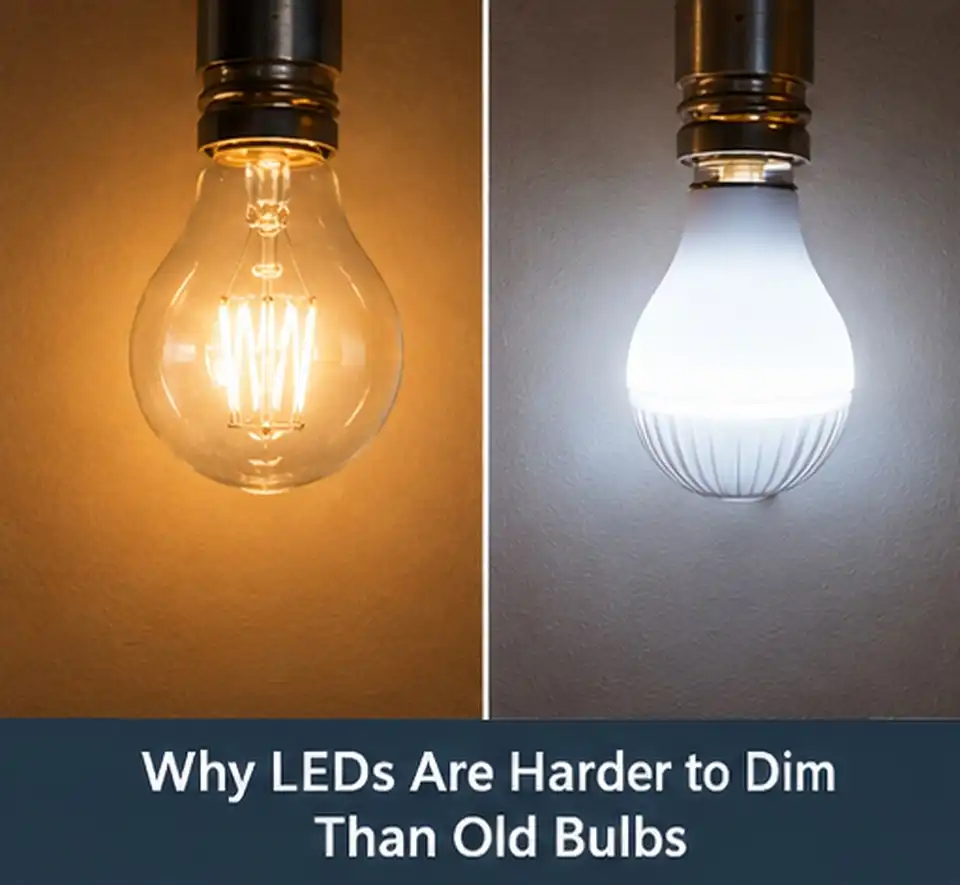
LEDs need electronics to dim. An incandescent bulb is a simple resistive load: lower the voltage and the filament glows less. An LED runs on a driver, a small circuit that converts 120-volt AC power into the low-voltage DC the diodes need. That driver decides whether, and how smoothly, the bulb can dim.
That difference explains most of the calls we take. A homeowner swaps old bulbs for LEDs, keeps the old dimmer, and suddenly gets flicker, buzz, or lights that won’t fully turn off. The bulb is not broken. The driver and the control are simply speaking different languages.
| Feature | Incandescent | LED |
|---|---|---|
| How it dims | Lower voltage = dimmer filament | Driver interprets the signal |
| Watts for ~800 lumens | 60 W | 8 to 10 W |
| Dims on any dimmer? | Yes | Only if labeled dimmable |
| Heat output | High | Low, but the driver is heat-sensitive |
| Typical life | About 1,000 hours | 15,000 to 25,000 hours |
Our Gov Certified technicians frequently see this in North Alabama homes built in the 1990s and early 2000s, where old incandescent-era dimmers still sit in the wall. Check the bulb box for the word “dimmable” before you try any method below.
Methods for How to Dim LED Lights Without a Dimmer Switch
You have eight practical options. Some take thirty seconds. Others call for a driver swap or a new control system. The table below compares them side by side so you can choose fast.
| Method | Best For | Wiring Changes? | Typical Parts Cost | DIY Friendly? |
|---|---|---|---|---|
| Smart bulbs | Lamps, ceiling fixtures, bedrooms | None | $10 to $25 per bulb | ✅ Yes |
| Plug-in lamp dimmer | Table and floor lamps | None | $10 to $30 | ✅ Yes |
| Inline cord dimmer | Corded lamps, string lights | None (plug-in models) | $8 to $20 | ✅ Yes |
| LED strip controller | Under-cabinet, cove, TV backlight strips | Low-voltage only | $10 to $40 | ✅ Usually |
| PWM inline controller | 12 V / 24 V strips and puck lights | Low-voltage only | $15 to $50 | ⚠️ Some skill |
| 0-10V driver system | Modern recessed and wafer lights | Yes, extra control wires | $40 to $150+ | ❌ Electrician |
| Multi-level / step-dim LEDs | Single fixtures, hallways | None | $8 to $30 | ✅ Yes |
| Lower-lumen bulb swap | Any socket | None | $3 to $8 per bulb | ✅ Yes |
The no-wiring options solve most single-room problems. Read the sections below to match each method to your exact fixture.
Smart Bulbs: The Fastest No-Wiring Fix
Smart bulbs dim through an app or voice command. Each bulb has a built-in radio and its own dimming driver, so your wall switch only supplies power. You leave the switch on and control brightness from your phone, a remote, or a speaker like Amazon Echo or Google Nest.
This is the simplest answer for anyone researching how to dim LED lights without a dimmer switch in a bedroom or living room. The catch: if someone flips the wall switch off, the bulb loses power and drops offline. Families with kids learn this quickly. A switch guard or a battery-powered smart remote mounted over the switch solves it.
Smart Lighting Protocol Comparison
| Protocol | Needs a Hub? | Range | Best Use | Watch Out For |
|---|---|---|---|---|
| Wi-Fi | No | Router range | 1 to 10 bulbs | Router overload with many bulbs |
| Bluetooth | No | About 30 to 50 ft | Single rooms | Limited away-from-home control |
| Zigbee | Yes (e.g., Philips Hue Bridge) | Mesh network | Whole-home setups | Hub cost upfront |
| Thread / Matter | Border router (many speakers include one) | Mesh network | Future-proof systems | Mixed device support |
Smart Bulb Pros and Cons
Pros:
- No wiring, no tools, no permit
- Full-range dimming, often down to 1%
- Schedules and scenes for evenings and wake-ups
- Many offer tunable color temperature (warm to cool white)
Cons:
- Wall switch must stay on
- Cost adds up across a room of recessed cans
- Depends on Wi-Fi stability
- Never install on an existing dimmer circuit
If you want app control for a full room of fixtures, our smart lighting installation team can set up switch-level controls so the whole family uses one system.
Plug-In Lamp Dimmers and Inline Cord Dimmers
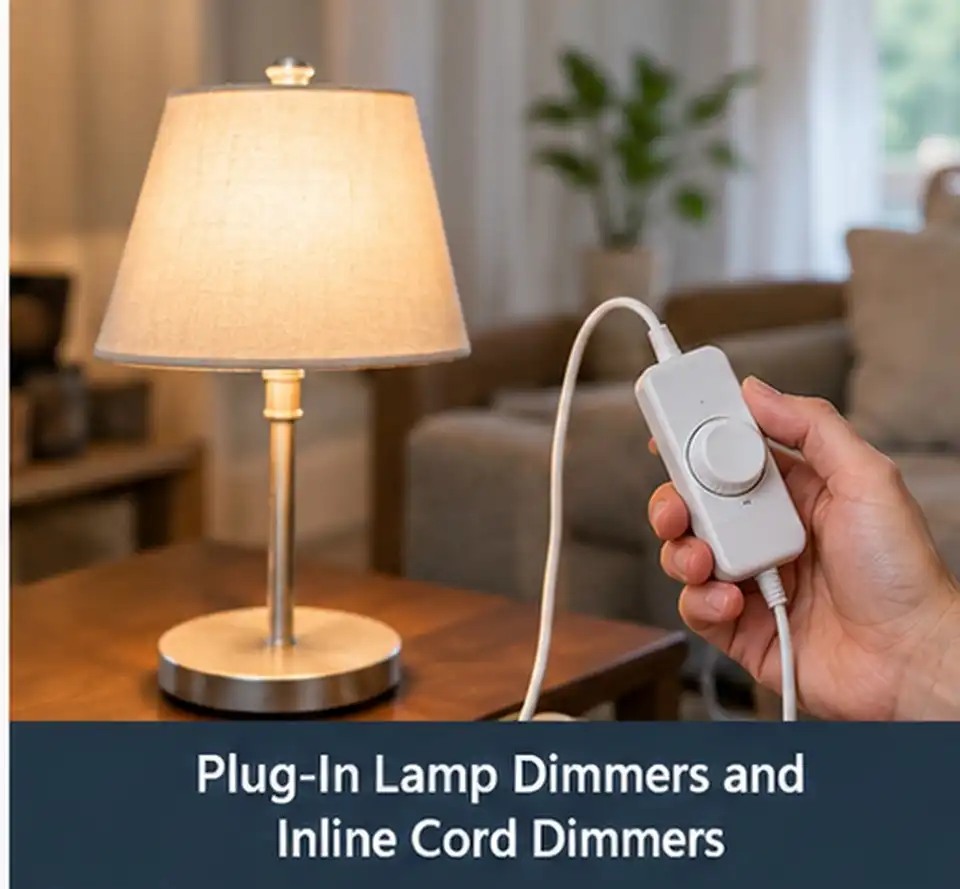
Plug-in dimmers add dimming to any corded lamp. You plug the dimmer into the outlet, then plug the lamp into the dimmer. Products like the Lutron Credenza use a simple slider or dial. Inline cord dimmers clip onto the lamp cord with a roller wheel.
These work only with dimmable LED bulbs. They must also be rated for LED loads, labeled “LED/CFL” on the package. Older incandescent-only plug-in dimmers cause the same flicker problems as old wall dimmers.
| Check Before You Buy | Why It Matters |
|---|---|
| “LED compatible” label | Older models flicker or buzz with LEDs |
| Wattage rating | Stay within the listed LED wattage limit |
| UL or ETL listing | Confirms safety testing |
| Bulb says “dimmable” | Non-dimmable LEDs can fail early |
| Grounded vs. 2-prong | Match your lamp’s plug type |
Plug-in dimmers are a smart move for renters and home offices. Pick up an LED-rated model and a dimmable bulb as a matched pair.
LED Strip Controllers and PWM Inline Controllers
LED strips dim through a controller, not a wall switch. Most strips run on 12-volt or 24-volt DC from a plug-in power supply. A small controller sits between the power supply and the strip, and you adjust brightness with an RF remote, app, or rotary knob.
How PWM Dimming Works
PWM (pulse width modulation, a method that switches the LEDs on and off very quickly) controls perceived brightness. At 50% duty cycle, the LEDs are on half the time. Your eye blends the pulses into steady, dimmer light, as long as the switching speed is high enough.
| PWM Frequency | What You Notice | Recommendation |
|---|---|---|
| Under 200 Hz | Visible flicker on phone cameras, possible eye strain | ❌ Avoid |
| 200 Hz to 1 kHz | Flicker at low brightness levels | ⚠️ Acceptable for accent lighting |
| 1 kHz to 3 kHz | Smooth to most eyes | ✅ Good for living spaces |
| Over 3 kHz | Essentially flicker-free, camera-friendly | ✅ Best for offices and video calls |
Strip Voltage Breakdown
| Spec | 12 V Strips | 24 V Strips |
|---|---|---|
| Max run before dimming at the far end | About 16 ft | About 32 ft |
| Current draw (same wattage) | Higher | Half of 12 V |
| Best for | Short under-cabinet runs | Long cove and soffit runs |
| Controller match | Must be rated 12 V | Must be rated 24 V |
This method is a solid answer for how to dim LED lights without a dimmer switch in kitchens, where under-cabinet strips often run on their own power supply. Match the controller’s voltage and amp rating to your strip. An undersized controller runs hot and fails early, especially inside a cabinet over a dishwasher or range.
Steps to Add a Strip Controller
- Unplug the strip’s power supply.
- Confirm strip voltage (12 V or 24 V) and total wattage.
- Choose a controller rated at least 20% above the strip’s wattage.
- Connect the power supply output to the controller input, matching polarity (+ to +).
- Connect the controller output to the strip.
- Plug in and test from 100% down to 5% brightness.
If your under-cabinet lights are hardwired to a wall switch instead of plugged in, the power supply is in a junction box. That’s work for our lighting installation crews, not a weekend project.
0-10V Drivers: Pro-Grade Smooth Dimming
0-10V dimming uses a separate low-voltage signal to set brightness. The fixture’s driver receives normal 120 V power on its main wires. Two extra wires, usually purple (+) and gray (–), carry a 0 to 10 volt DC signal. At 10 V the light runs full brightness. As the signal drops toward 1 V, the light dims.
This system is common in commercial buildings, and it’s growing in homes with LED wafer lights and linear fixtures. It avoids the flicker that plagues phase dimmers. It does, however, need a 0-10V controller: a wall control like the Legrand radiant 0-10V dimmer, a wireless controller, or a driver with a built-in potentiometer (a small adjustment knob) for fixed set-point dimming.
0-10V Specs at a Glance
| Spec | Typical Value | What It Means for You |
|---|---|---|
| Signal range | 0 to 10 V DC | Higher voltage = brighter light |
| Control wires | Purple (+), Gray (–) | Extra wires needed between control and fixture |
| Wire class | NEC Class 2 low voltage | Must be separated from 120 V wiring or rated for it |
| Minimum dim level | Often 1% to 10% | Some drivers can’t dim fully off |
| Dim-to-off | Driver-dependent | Many need a separate relay or switch to cut power |
| Sink vs. source | Most residential drivers “source” current | Controller must match driver type |
Our Gov Certified technicians see 0-10V most often in new builds around Madison and the Clift Farm area. Older homes rarely have the extra control wiring, so adding it means fishing new cable through walls. That’s why 0-10V belongs on the electrician’s side of the line.
0-10V Pros and Cons
Pros:
- Smooth, flicker-free dimming
- Long control runs with little signal loss
- Works with many fixtures on one control
Cons:
- Needs extra wiring most homes lack
- Requires 0-10V-rated drivers in every fixture
- Code rules on Class 2 separation apply
Ask for a 0-10V quote when you’re already remodeling, since walls and ceilings are open.
Multi-Level and Step-Dimming LED Fixtures
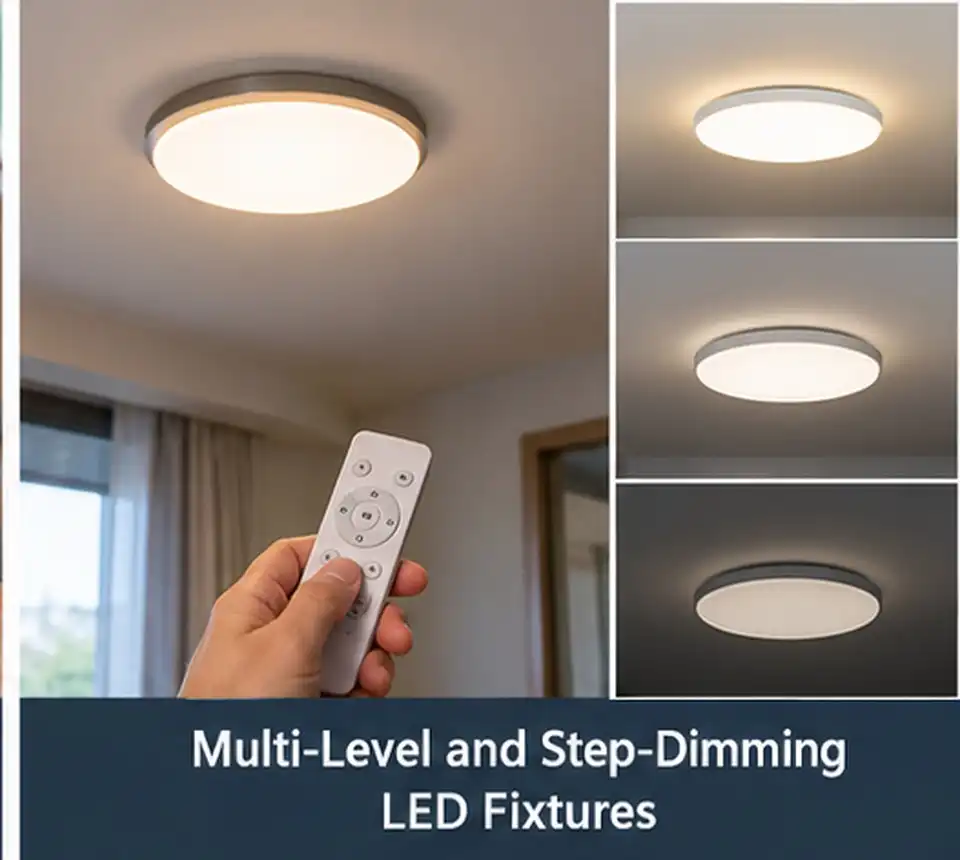
Step-dimming LEDs change brightness using your existing on/off switch. You flip the switch off and back on within a second or two, and the bulb cycles through preset levels, often 100%, 50%, and 10%. Philips SceneSwitch bulbs and similar products work this way.
Other fixtures have a selectable lumen switch on the housing. Many LED wafer lights and flush-mount fixtures let you pick a lower output during install with a small slide switch. These fixtures often include a CCT selector too, letting you choose 2700K, 3000K, 3500K, 4000K, or 5000K.
| Fixture Type | How It Dims | Adjustable Later? | Best Spot |
|---|---|---|---|
| Step-dim bulb | Switch toggling | ✅ Yes, anytime | Bedrooms, hallways |
| 3-way LED bulb | 3-way lamp socket | ✅ Yes | Floor and table lamps |
| Lumen-selectable fixture | Slide switch on housing | ⚠️ Only with fixture access | Kitchens, closets |
| Night-light mode fixture | Toggle sequence or built-in sensor | ✅ Yes | Kids’ rooms, bathrooms |
Step-dimming is one of the cleanest answers to how to dim LED lights without a dimmer switch, since nothing changes in the wall. Just never put these bulbs on an existing dimmer. The toggle memory gets confused and the bulb may flicker.
For full-room planning, including where step-dim fixtures fit best, our indoor lighting design service lays out brightness by room and task.
Lower-Lumen Bulb Swaps: The Simplest Permanent Fix
Lower-lumen bulbs reduce brightness for good. Many homeowners buy “100-watt equivalent” LEDs out of habit, then wonder why the room feels harsh.
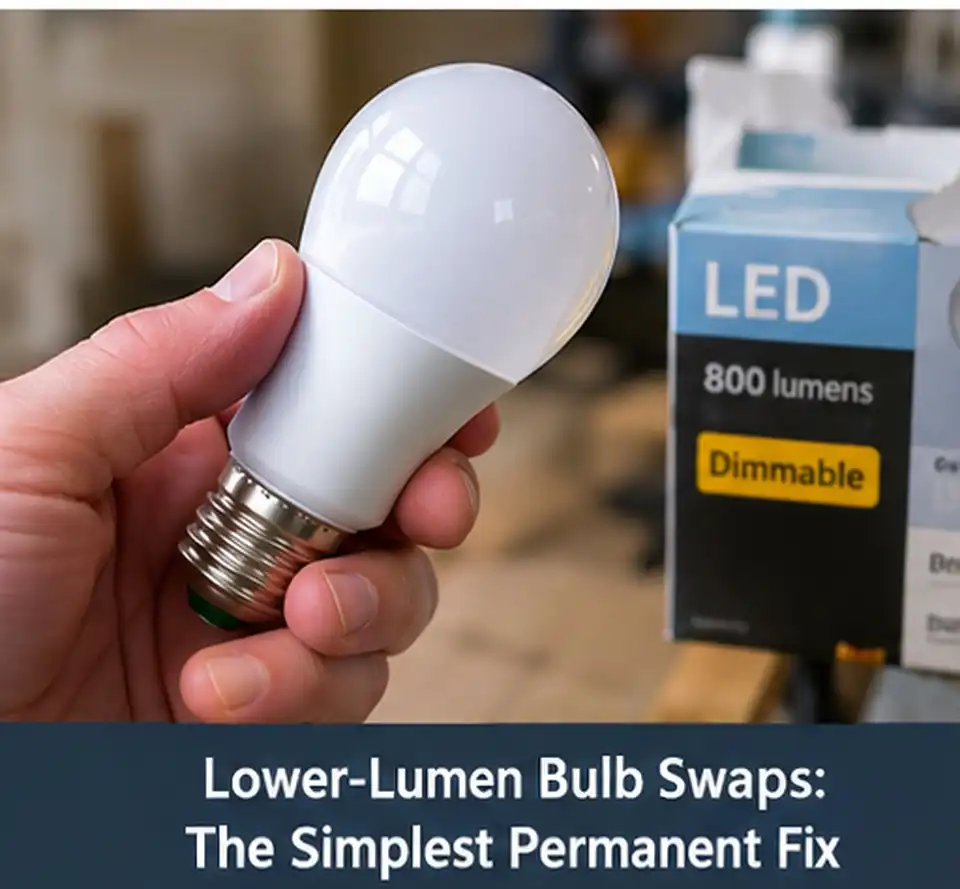
Lumens (the actual measure of light output) matter more than watts. Dropping one step down the lumen scale often solves the problem completely.
Lumens-to-Watts Swap Guide
| Old Incandescent | LED Equivalent Watts | Lumens | Good For |
|---|---|---|---|
| 25 W | 3 to 4 W | About 250 | Accent lamps, night lights |
| 40 W | 5 to 6 W | About 450 | Bedrooms, reading nooks |
| 60 W | 8 to 10 W | About 800 | General living spaces |
| 75 W | 11 to 13 W | About 1,100 | Kitchens, work areas |
| 100 W | 14 to 17 W | About 1,600 | Garages, task lighting |
Color Temperature Changes How Bright Light Feels
| Color Temp | Look | Perceived Brightness |
|---|---|---|
| 2700K | Warm, cozy, amber | Feels softest |
| 3000K | Warm white | Soft and clean |
| 3500K | Neutral | Balanced |
| 4000K | Cool white | Feels brighter |
| 5000K | Daylight | Feels harshest at night |
On recent service calls across Madison County, we’ve found that swapping 5000K, 1,100-lumen bulbs for 2700K, 800-lumen bulbs fixes most “too bright” complaints. No electronics needed. Look for the ENERGY STAR label to confirm efficiency and lumen accuracy. You can compare certified products through the ENERGY STAR certified light fixtures finder, and the U.S. Department of Energy’s LED lighting page explains how LED efficiency compares to older bulbs.
Heat, Humidity, and LED Life in North Alabama
Heat shortens LED driver life. LEDs run cooler than incandescent bulbs, but the driver’s electronics still degrade faster in hot spaces. If you’ve spent a summer in Huntsville, you know attic temperatures can climb past 130°F. Recessed cans in the top-floor ceiling sit right under that heat.
This matters for dimming. A stressed driver dims unevenly, flickers at low levels, or drops out entirely. Running LEDs at lower brightness does reduce driver heat slightly, but the bigger fix is choosing the right rated product.
| Location | Risk | What to Buy |
|---|---|---|
| Recessed cans under attic | High heat | IC-rated fixtures, enclosed-fixture-rated bulbs |
| Bathrooms | Humidity and steam | Damp-rated fixtures |
| Covered porches | Humidity, temperature swings | Damp- or wet-rated fixtures |
| Enclosed globe fixtures | Trapped heat | Bulbs marked “enclosed fixture rated” |
| Near HVAC returns or air handlers | Vibration, dust | Sealed, airtight (AT) rated housings |
HVAC coordination plays a role here too. Unsealed recessed cans leak conditioned air into the attic, which makes your AC work harder during humid July evenings. When we replace old cans, we install airtight, IC-rated LED wafers that dim better and reduce air leakage. A home with smart lighting and a smart thermostat can also share scenes and schedules, so lights dim as the system shifts to evening setpoints.
Check your fixture labels for IC and AT ratings before buying replacement bulbs or dimmable retrofits.
When a Proper Dimmer Switch Upgrade Is the Right Answer
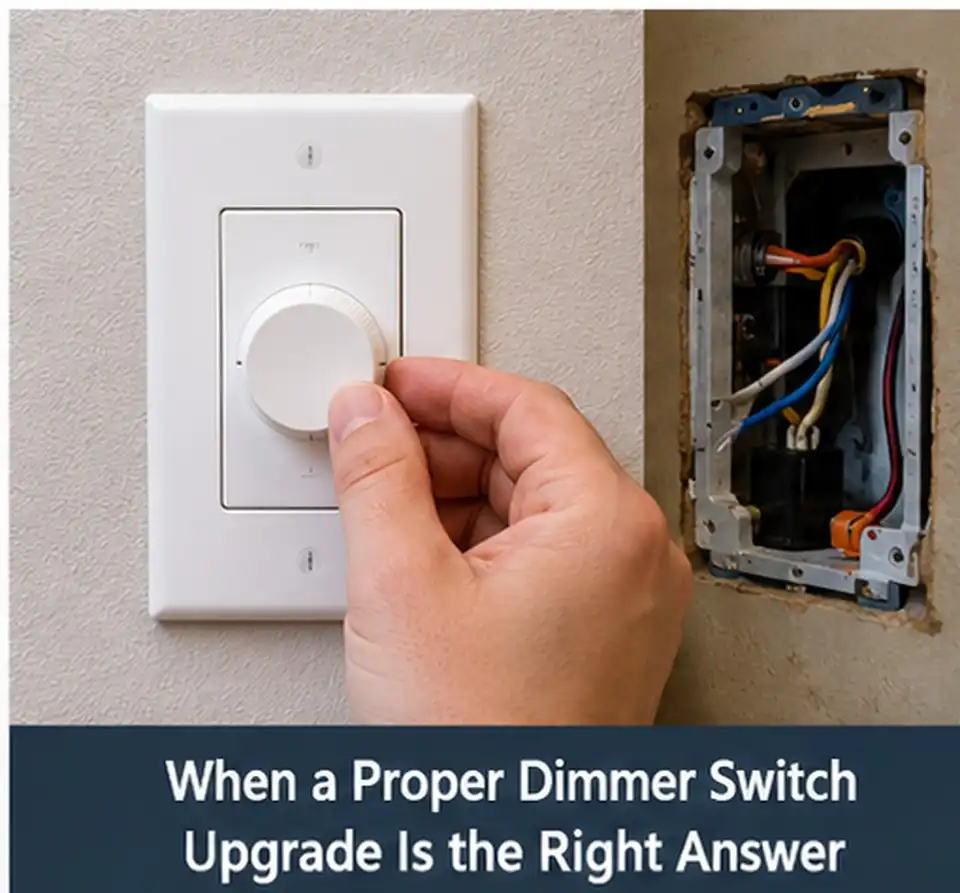
A dimmer switch upgrade is the right answer for whole rooms of hardwired lights. Smart bulbs in eight recessed cans can cost more than one quality LED dimmer. Workarounds also can’t help fixtures with integrated LEDs that have no replaceable bulb.
Sometimes learning how to dim LED lights without a dimmer switch leads you to the conclusion that a dimmer is simply the better tool. That’s a fair outcome. Modern LED dimmers bear little resemblance to the old rotary dials from the 1980s.
Signs You Need a Real Dimmer
- Four or more recessed lights on one switch
- Integrated LED fixtures (no screw-in bulb)
- You want wall control, not a phone app
- Multiple switch locations (3-way or 4-way setups)
- You’re already remodeling or replacing switches
LED Dimmer Types Compared
| Dimmer Type | Also Called | Works With | Strengths | Limits |
|---|---|---|---|---|
| Forward phase | TRIAC, incandescent-style | Many dimmable LED bulbs | Low cost, widely available | Can buzz or flicker with some LEDs |
| Reverse phase | ELV (electronic low voltage) | Many LED drivers | Smooth, quiet dimming | Higher price, check compatibility |
| CL-rated | LED/CFL dimmer | Dimmable LED and CFL bulbs | Adjustable low-end trim | Must match bulb list |
| 0-10V | Low-voltage control | 0-10V drivers only | Flicker-free, scalable | Needs extra wiring |
| Smart dimmer | Wi-Fi, Z-Wave, Zigbee | Most dimmable LEDs | Schedules, voice, app | Many require a neutral wire |
Neutral wire requirements catch many homeowners off guard. The National Electrical Code has required a neutral at most switch locations since the 2011 edition, but plenty of North Alabama homes were built earlier. Many smart dimmers simply won’t work without one. We check the box before recommending a model.
Our light switch and dimmer installation service includes a compatibility check against your bulbs, a low-end trim adjustment, and proper 3-way wiring where needed. For new can lighting paired with dimmers, see our recessed lighting installation page.
Troubleshooting LED Dimming Problems
Most LED dimming problems trace back to mismatched parts. The symptom usually points straight to the cause. Use this table before you replace anything.
| Symptom | Likely Cause | Fix |
|---|---|---|
| Flicker at low brightness | Dimmer and driver mismatch | Adjust low-end trim or swap to a CL / ELV dimmer |
| Buzzing or humming | Forward-phase dimmer with sensitive driver | Try a reverse-phase dimmer or different bulb brand |
| Ghosting (faint glow when off) | Leakage current through the dimmer | Use a dimmer with a neutral or add a load bypass |
| Lights drop out before minimum | Below the dimmer’s minimum load | Raise low-end trim or add fixtures to the circuit |
| Smart bulb unresponsive | Wall switch turned off, or on a dimmer | Leave switch on, remove dimmer from circuit |
| Strip dims at far end | Voltage drop on a long 12 V run | Shorten run or switch to 24 V |
| Bulb dies early | Heat or non-dimmable bulb on dimmer | Use dimmable, enclosed-rated bulbs |
Steps to Troubleshoot Safely
- Confirm every bulb on the circuit says “dimmable.”
- Check that all bulbs are the same brand and model. Mixed bulbs dim unevenly.
- Remove smart bulbs from any circuit with a dimmer.
- Test one known-good bulb in the fixture.
- Note whether the problem happens at all brightness levels or only at the low end.
- Call a licensed electrician if flicker affects multiple rooms. That can signal a loose connection, not a dimming issue.
House-wide flicker is a wiring concern. Our flickering lights guide explains when it points to a loose neutral or service problem.
DIY Safety Warnings: Where to Draw the Line
DIY dimming is safe until you open a switch box. Plug-in dimmers, smart bulbs, step-dim bulbs, and lumen swaps carry essentially no shock risk. Anything touching 120-volt wiring, junction boxes, or driver replacement changes the picture.
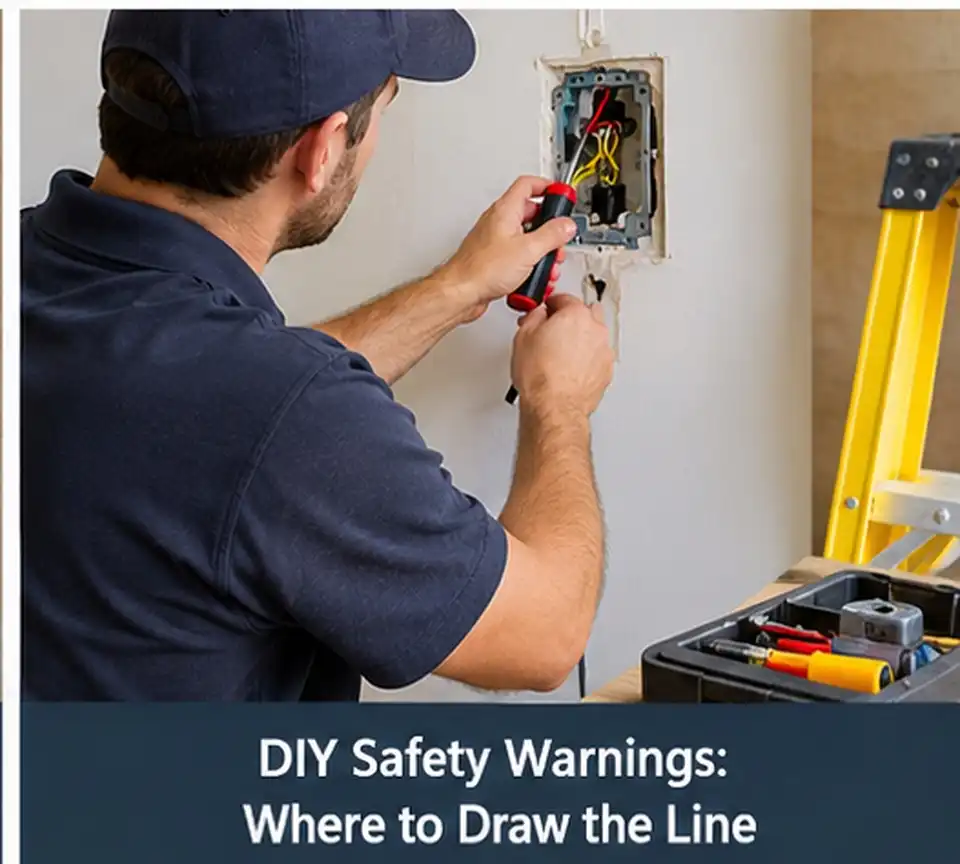
Alabama requires electrical contractors to hold a license through the Alabama Electrical Contractors Board. Always ask for the license number and proof of insurance before work starts.
Safety Checklist
| Task | DIY OK? | Why |
|---|---|---|
| Screw in smart or step-dim bulbs | ✅ Yes | No wiring contact |
| Use plug-in or inline cord dimmers | ✅ Yes | Plug-and-play |
| Add a controller to plug-in LED strips | ✅ Yes | Low-voltage DC only |
| Swap to lower-lumen bulbs | ✅ Yes | Turn the fixture off first |
| Replace a wall switch with a dimmer | ❌ Electrician | 120 V wiring, neutral and ground checks |
| Replace LED drivers in fixtures | ❌ Electrician | Line-voltage connections in tight housings |
| Add 0-10V control wiring | ❌ Electrician | NEC Class 2 separation rules |
| Hardwired under-cabinet power supplies | ❌ Electrician | Junction box work |
| Any work with aluminum branch wiring | ❌ Electrician | Special connectors required, fire risk |
Never Do These
- Never use a light dimmer to control a ceiling fan motor. Fans need a rated fan speed control.
- Never install a resistor or homemade circuit to “dim” an LED fixture.
- Never put non-dimmable LEDs on a dimmer, even turned all the way up.
- Never exceed the dimmer’s LED wattage rating.
- Never work in a box without turning off the breaker and verifying with a non-contact voltage tester.
Stop and Call Right Away If You Notice
- A burning or hot-plastic smell from a switch or fixture
- A switch plate warm to the touch
- Scorch marks or melted plastic on a dimmer
- Sparks when flipping a switch
Those signs mean overheating. Turn off the breaker and call for help.
How to Dim LED Lights Without a Dimmer Switch Huntsville AL Homeowners Can Count On
Local homes come with local quirks. Older neighborhoods near Five Points and Blossomwood often have ungrounded boxes and no neutral at the switch. Newer builds in Madison, Harvest, and Athens usually have neutrals but use integrated LED wafers that need compatible dimmers. Rural homes in Jackson and DeKalb counties often see voltage fluctuations during storms, which can make cheap LED drivers flicker.
Knowing how to dim LED lights without a dimmer switch in Huntsville AL homes means matching the method to the house, not just the bulb. Here is how we match the fix to common home types across North Alabama.
| Home Type | Common Wiring | Best No-Dimmer Method | Upgrade Path |
|---|---|---|---|
| Pre-1970 homes | No neutral, possible ungrounded boxes | Smart bulbs, lamp dimmers, lumen swaps | Electrical inspection before smart switches |
| 1980s to 2000s homes | Neutral often missing at switch | Step-dim bulbs, smart bulbs | No-neutral smart dimmers or rewiring |
| 2011+ builds | Neutral at switch | Lumen-selectable fixtures | Smart dimmers or 0-10V on remodel |
| Rural properties | Long service runs, storm surges | Lumen swaps, quality dimmable bulbs | Whole-house surge protection |
Our Gov Certified technicians serve Huntsville, Madison, Decatur, Athens, and communities across seven North Alabama counties. Call with your address and fixture details, and we’ll tell you which method fits before anyone touches a wire.
FAQs
Can I dim a non-dimmable LED bulb?
No. A non-dimmable LED lacks the driver circuitry to handle reduced power. On a dimmer, it will flicker, buzz, or fail early. Your only options are a lower-lumen bulb, a step-dim bulb, or a smart bulb that dims internally.
Do smart bulbs work on a regular light switch?
Yes. Smart bulbs need the switch left on at all times. They dim through their own internal driver controlled by an app, remote, or voice assistant. Turning the switch off cuts their connection.
What’s the cheapest way to dim LED lights?
A lower-lumen bulb is the cheapest permanent fix at a few dollars per bulb. For adjustable dimming, a plug-in lamp dimmer with a dimmable LED costs under $40 total. Both answer how to dim LED lights without a dimmer switch without touching any wiring.
Why do my LED lights flicker when dimmed?
Most flicker comes from a dimmer and driver mismatch. Older forward-phase dimmers weren’t designed for LED loads. A CL-rated or reverse-phase dimmer with adjustable low-end trim usually fixes it.
Is 0-10V dimming worth it for a home?
It’s worth it during new construction or a major remodel. The extra control wiring is easy to run with open walls and costly to add later. For finished homes, smart dimmers usually deliver similar results with less work.
Do I need a permit to install a dimmer in Alabama?
Simple device replacements like a switch-to-dimmer swap usually don’t require a permit. New circuits, new fixture locations, and remodel wiring typically do. Your local building department in Huntsville or Madison sets the final rules.
Get the Right Light Without the Guesswork
Softer, adjustable light starts with matching the method to your fixture and wiring. Start with the easy wins: dimmable smart bulbs, plug-in dimmers, and lower-lumen swaps. When your project involves recessed cans, hardwired strips, or a new dimmer switch, the work moves into the wall box, and that’s where a licensed electrician belongs.
At Huntsville AL Electricians, we connect North Alabama homeowners with Gov Certified, licensed residential electricians who test compatibility, check for neutrals, and set dimmers up right the first time. Call (855) 321-3149 and describe your fixtures to get clear next steps for your home.